South by South Give Me My Damn Maple Syrup
South by South Give Me My Damn Maple Syrup
Product and Politics on the White House Lawn
By Paul Ford, co-founder, Postlight

Last Monday, Postlight co-founder Rich Ziade and I attended South by South Lawn, the White House’s take on South by Southwest. In many ways the event resembled Any Old Technology Conference — lots of small tents showcasing various organizations and projects, and a booth sponsored by Starbucks. It was a noticeably more diverse showing than a lot of conferences, however, and the focus of the booths, talks, and panels was powerfully on civics throughout. However, every now and then, you’d turn to your left and there was the White House, just kind of standing there. It was wild. Rich made a video:
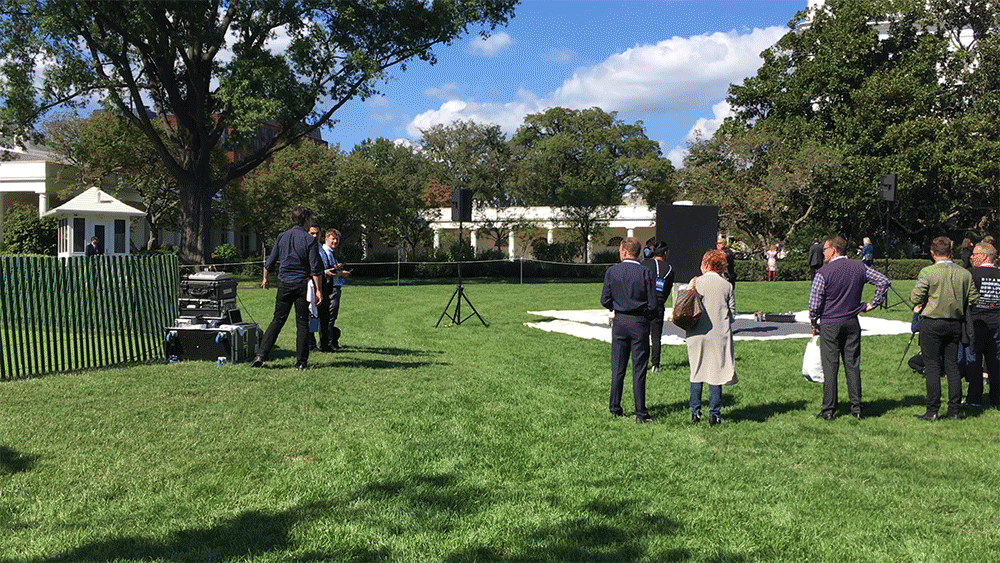
Everything you look at has a backstory. Maybe Mamie Eisenhower planted that tree? Maybe Theodore Roosevelt’s kid’s pony pooped right where you were standing? Apparently there are a lot of snipers, but we didn’t see any. I guess that’s the point.
Having been to South by Southwest, this event was a relief. You didn’t have to brace yourself before a conversation opened. No one was trying to stuff business cards into your face while screaming about lead generation. A guy came up and chatted with us; he makes soccer balls that don’t deflate, so that kids in conflict zones can play games. There was a VR experiment that showed you the National Parks and there was a VR experiment that showed you what it’s like to be in solitary confinement. There were lots of tables where you could sit and chat and eat your box dinner.
The theme of this event was, okay, of course, innovation — tech innovation, cultural innovation, civic engagement. Innovation is basically a nice way of saying “your old way is bad, do this instead.” As a technology company we are expected to have an opinion on innovation, and — we’re for it!
Of course we are. But one of the things that has emerged in the give-or-take eight billion hours Rich and I have spent together over the last year starting up Postlight is that while we are exhausted and frustrated by bureaucracies — because large, bureaucratic organizations are basically immune systems that fight off any form of change, and we like change! — we are very sympathetic to the people within them.

All human beings end up in positions where we have a job to do, and we do our job, and we don’t fully understand what happens to the left or right of us, or up or down a few levels in the hierarchy. We just have to do our job. And along comes “innovation” and completely screws you up. I mean think of your favorite restaurant. Maybe they make pancakes. You go there once week. And you go one day, and they say, “hey, next month we’re thinking of putting peanut butter on the pancakes.” And you’re like, okay, fine. Whatever. But the next week they’re like, “oh yeah! Peanut butter pancakes are coming.” And you say, “hey, I like maple syrup.” And they say, “oh wait, peanut butter is cheaper and ultimately more filling. You’re gonna love it.”
Sure, sure. You go home. And they repeat it the third week and you say, “Listen, if you do this, I won’t order it. I might eat peanut butter pancakes once, but I am not about to do it every time I come in. You hear me?” You get that look in your eye. And the waiter wants his tips and the chef wants her job and the manager doesn’t want to lose a customer. So they give you maple syrup. And the peanut butter project is still ongoing but it’s just for new customers who come in.
The thing is, peanut butter might be delicious. It’s definitely cheaper than maple syrup. But people know what they like. So what do you do to change a maple syrup situation into a peanut butter situation? (This is how serious business people talk, right? Cheese-moving, etc.)
What we’ve observed is that speed makes all the difference. You just have to move fast as hell, and break through the immune system, and infect the host organization with your ideas. Whcih means you have to do something kind of awesome. Something where people really want to use your thing instead of the old busted thing. Where they feel smart and cool and connected.

One of the key questions you can ask about any product is “what superpower does this give the user?” People like power! Often you just hand them more process. They have enough of that. What you really want is informed consensus. Which is another way of saying, “politics.” Getting people bought in, helping them see their self-interest. Big crappy software projects that take forever make that almost impossible. But fast, quickly-created solutions that let people see themselves and their future work-lives in a better light, these can work.
On our end we’re starting to put more and more of our energy into creating a Labs where we can do two-month projects for ourselves, or with our clients and partners — so that they can put the slide deck together and the working mobile prototype, and walk that around through an organization and show people what their future superpowers look like. Our hypothesis is that, if we can get something real — something that lets a user feel the possibilities — into human hands in two months, with a few PowerPoint slides to the left and right of it, that’s actually better than a campaign promise.