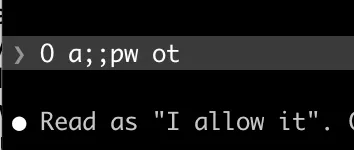
everyone is like “it will achieve sentience and kill us all” but THIS is what's gonna kill us
 ➛
➛
Alt Text: Terminal screenshot. The user has typed: O a;;pw ot Claude has responded: Read as "I allow it".
Alt Text: Terminal screenshot. The user has typed: O a;;pw ot Claude has responded: Read as "I allow it".

Alt Text: A subway stop in NYC. Two girders made up of odd shaped metal subsections extend platform to roof, wrapped in rubber numbers and zebra striped yellow and white tape. They taper to a huge screw at the bottom which is inserted into a broad flat metal foot, giving the whole thing an iron-giant-chicken-foot vibe. It does not in any way seem great or indicative of a robust and forward-looking attention to public infrastructure.
Last week was fun. We launched tinylittleoffice.com—you heard it here first!—and it turned out that lots of folks were in the market for an “office suite that stores data in the URL.”
So many people visited that the server went down (well, I maxxed out the CloudFlare free plan), and ultimately, after I put in my credit card, a couple hundred thousand people came by to check it out. People on Hacker News insisted it was a pointless waste of time, and folks on GitHub started asking for features and fixes, all of which we’re considering, and some of which we’re doing. The Register wrote an article about it, and it also made it, for a little while, to the top ten of Product Hunt.
So all good; we will continue to support and enhance it, bit by bit, while we also do stable software development work for our customers and clients. But I did want to pause for a second and point out something that surprised me about the process. It’s this:
The web browser is very, very, very powerful software for building applications.
I know that is obvious and is the sort of thing I could have said any time in the last 20 years. But now there’s an addendum to the statement:
The web browser is very, very, very powerful software for applications, and the cost of accessing that power is going down seemingly every day.
I put maybe twice as much effort into building a web-based office suite as I might normally put into writing a long newsletter post. I’m not telling you this because I am a very special boy. I’m telling you because if you want to, you can learn to do it, too.
Fast, cheap, good, right? But even after I had to put in my credit card, CloudFlare hosting costs…$0. Partly because I optimize for cheapness, but partly because that’s just how it goes these days. Fast? Dear God, computers are fast, and software development is also fast compared to the past. But as I code web apps, I keep finding new corners of the browser I didn’t know well. Things are just…wild in there.
And on and on. The web is really the greatest distribution platform imaginable right now. It’s inherently multilingual—I released TinyLittleOffice in 21 languages (the most common NYC ones, which is why it has Creole and Yiddish), with lots of infrastructure for accessibility. Plus, of course, JavaScript is a full-featured programming language, and HTML can represent most things a document can do on a computer; if you need something more old-school, PDF.js lets you deal with PDFs in the browser. I think you can even hyphenate text reliably these days, although I refuse to believe it.
I knew these things existed. I’d even programmed with them. But I’d never really looked closely; I just downloaded whatever open-source code would make it easier to build and tried to drag software across the finish line.
My quirky 1990s-vintage office suite might not convince you—it’s weird and small. So take a look at Simon Willison’s new web-based browser 3D game, Battle Drones. He’s hosting it on GitHub. He wrote it himself. He’s not a games builder. It just pops right up in the browser and you play it. It’s multiplayer, and it works offline.

… but I can now see a path to vibe coded games like this being taken seriously. Battle Drones is fun, it looks good, it has innovative features (the multiplayer-over-audio thing is a first for an RTS as far as I can tell). I’d love to see what someone with better taste than me and a driving passion to produce something truly exceptional could build!
All the various cool browser technologies have been around for years. But they are each extremely vast. If you get good at Web Audio, you probably don’t have time to get good at Web Crypto and Web Assembly and WebGL.
The reason they were so complex is, basically, because they were built for teams like those at Google, not for individuals. In the past, the web was for people to build web pages—and, yes, in the present, you can still do that, but for more than a decade, the web has been designed for giant companies so they can deliver software securely to billions of people who buy things with credit cards. These huge mega-libraries were dropped into the web browser to enable large teams to build big things, and the little guy was a bit of an afterthought. But now you can make a game in 3D with sound, and it can work just fine on a plane.
This is one of the places where “are we in an AI bubble” gets fuzzy for me, because it’s totally clear all these giant AI companies are huffing AGI paint fumes, but at the same time, if we actually unlocked the economic transformation of, say, 100 times as many people making software for each other, that would blow an enormous crater into the current tech economy. Don’t like the way your giant industrial looms make carpet? Hack your own firmware and make each carpet totally personalized! Turn any Instagram post into a huge floor covering! Suddenly all the carpet companies have to hack their own firmware to compete. What’s that going to be like?
This also destabilizes the app store economy. The high tax of building for app stores seems less worth paying when you can just test an idea in the world from a web server for $0 after a couple weeks. Perhaps Mozilla should take another swing at launching a mobile phone! (Forget I mentioned that.) In any case, what used to be a large industrial process is now a personal one, if you so desire. Web browsers enable incredibly rich app development—and that’s radically easier than it used to be.
It’s a mixed blessing. I’ve been a writer for years, and software development feels more and more like writing to me every passing week. The awkward part of the comparison is, in general, people do not want to pay writers any money at all. As a writer, you get used to it. But for software people, being perpetually devalued is pretty novel. Then again, if you need software to do something—like our clients!—say, to fix a process, organize a database, get more value out of a big piece of industrial equipment, it’s a pretty amazing time, because you can do just about anything. I’m pretty confident we’ll all meet in the middle, but it’ll take a while, and it will be different on the other side.
Paul and Rich are ready to answer your questions about AI—and beyond. On the inaugural episode of “Ask Aboard,” they tackle a trio of queries from some familiar faces. First, NYU’s Vice Provost for AI and Technology in Education, Clay Shirky, asks how we can personally protect ourselves in the wake of the Hugging Face incident. Next, an anonymous letter-writer wants to know how to deal with clients who can’t stop generating bad AI artifacts. And finally, journalist and editor Josh Tyrangiel gets to the heart of it all, asking: What’s the software equivalent of yacht rock?

Paul and Rich are ready to answer your questions about AI—and beyond. On the inaugural episode of “Ask Aboard,” they tackle a trio of queries from some familiar faces. First, NYU’s Vice Provost for AI and Technology in Education, Clay Shirky, asks how we can personally protect ourselves in the wake of the Hugging Face incident. Next, an anonymous letter-writer wants to know how to deal with clients who can’t stop generating bad AI artifacts. And finally, journalist and editor Josh Tyrangiel gets to the heart of it all, asking: What’s the software equivalent of yacht rock?
[Quoted post]➛
[Quoted post]➛
[Quoted post]➛

Six years ago, when we were running a different company, my Aboard co-conspirator Rich Ziade had a great software idea. He called it TinySheet, and it was a ten-line spreadsheet that ran in the browser and kept all the data in its URL. That meant two things:
Our team did a great job building this utility, and people used it and wrote about it. As far as we could tell, folks mostly used it to share simple math in Slack. Later we launched a similar tool called TinyCalendar.
We moved on, and sadly, those sites fell off the web, and the old links all broke.
Now it’s 2026. Rich and I have co-founded a different firm, Aboard. We still build things for ourselves and our clients. And software is very different now. I thought to myself: What if I took Rich’s TinySheet idea and ran with it?
The result is TinyLittleOffice.com. It works using the same principles, but it also has a word processor, outliner, presentation builder, fuller-featured spreadsheet, calculator, drawing tool, diagram maker, animator, calendar, and trip planner. Here it is in my web browser:
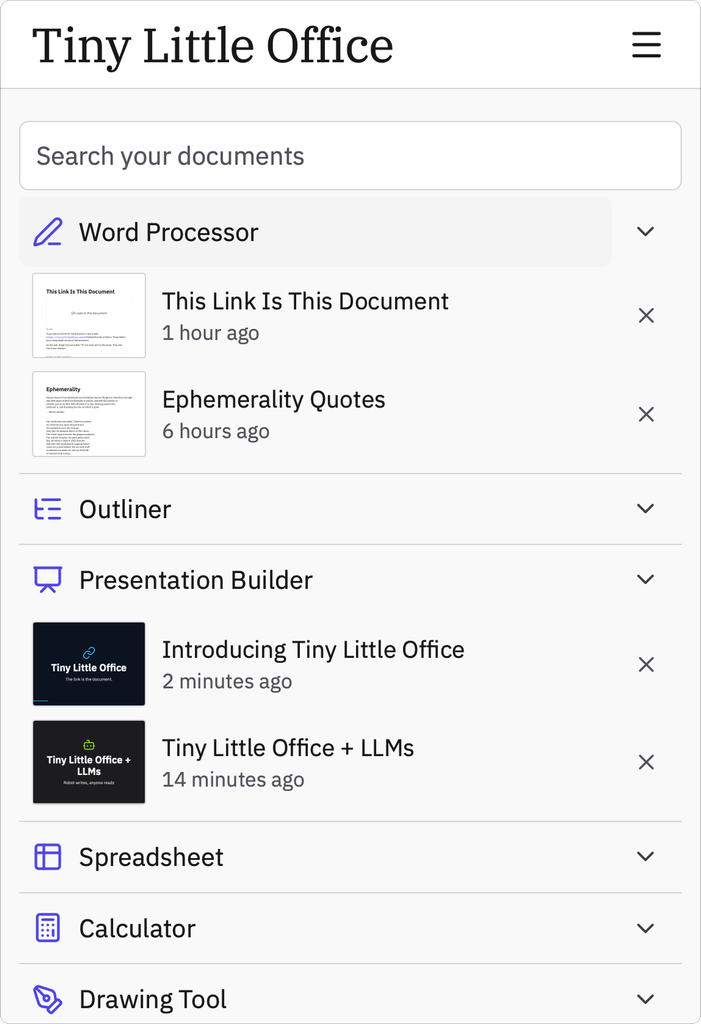
It’s for tiny documents—a couple pages, a few slides. And it still saves all the data in your link.
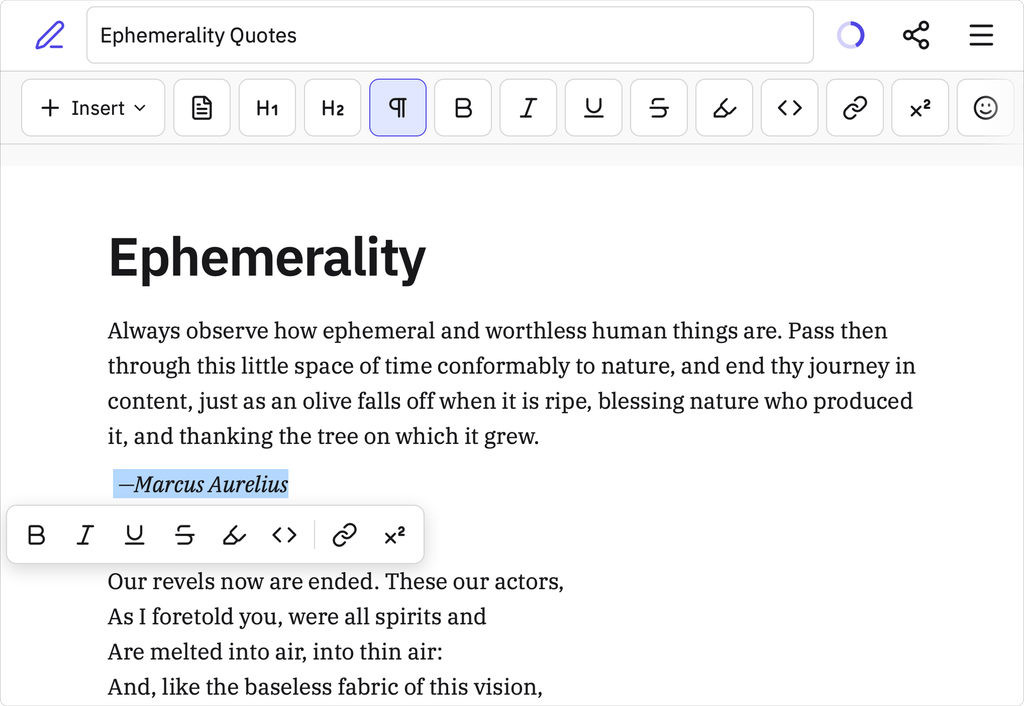
Say you head to TinyLittleOffice.com and make a document. Now what? When you want to “save” a document you can:
There are lots of tradeoffs. This is not, in any way, how web apps are expected to work. The links can get unwieldy pasted in chat, and you can’t upload video or images, full stop. It’s not collaborative like Google Docs. It’s collaborative like handing out zines at a street fair.
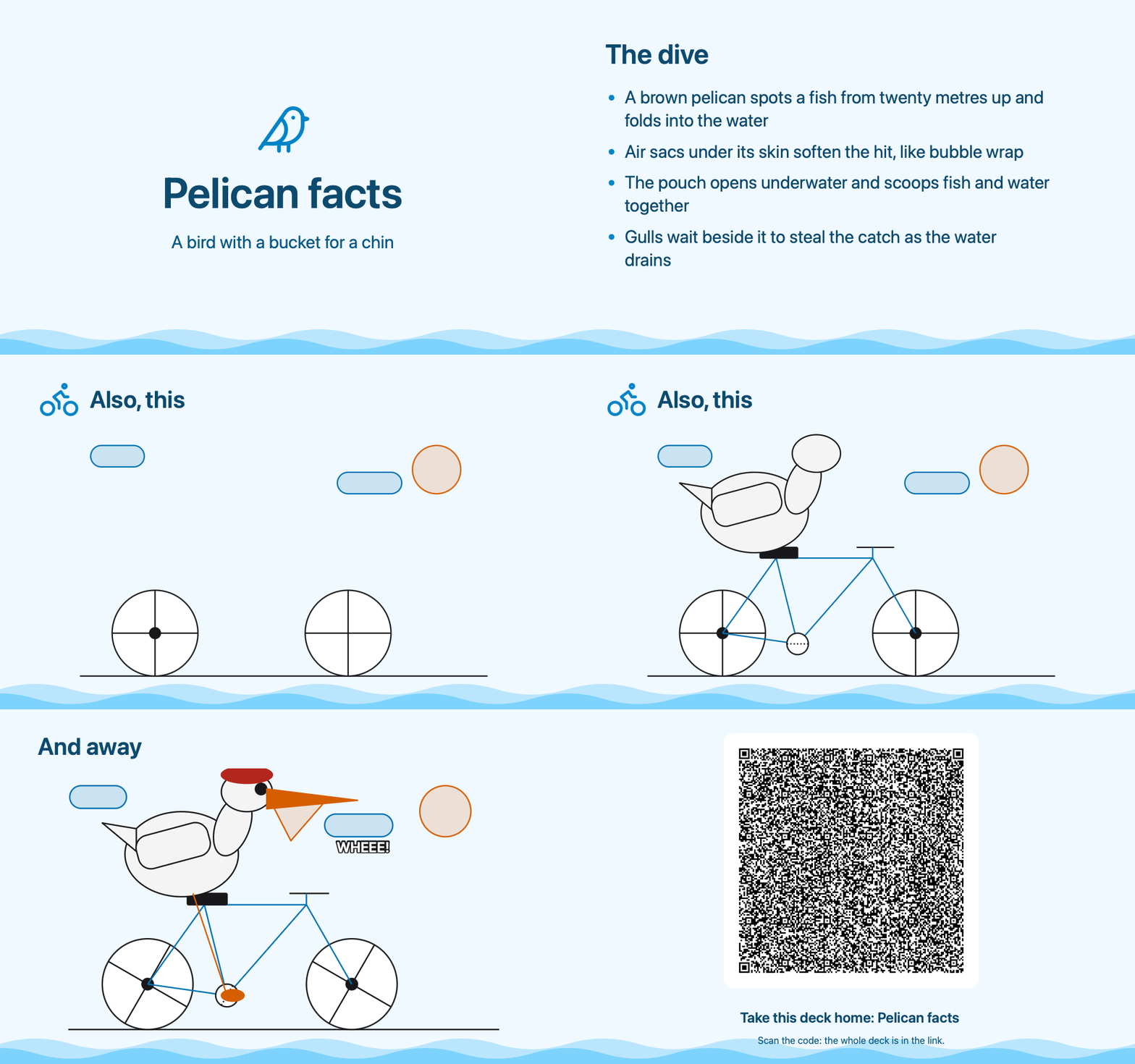
I guess there are a few different ways of thinking about it:
But ultimately, it’s just software. It’s for using, and you’ll decide what it’s for and if it meets any of your needs.
In the meantime:
Everything in tech is huge right now. Every system lives on someone else’s machine and tracks you everywhere. All the content you make with those systems is being gobbled by LLMs. Meanwhile, most normal people are in chat all day, hiding out from the mess, rambling about politics and sports on WhatsApp or coordinating mutual aid on Signal. I really enjoyed building something for them/us.
I also just kind of…like using this thing. It’s light and it doesn’t give me many options, and when I need to save something I just Slack it to myself. The outliner is my favorite part. It also allows you to embed documents in other documents, which was the dream of the entire 1990s in office software—and now that dream is extremely true.
Rich’s point in producing TinySheet was simple: Small, private things may not be profitable, but they can be valuable. People like little tools they can make their own. It’s your data, and your code. I think all of that holds even more true six years later. And it really is easier to build small than ever before.
This project is open source with the MIT license. Feel free to find fault with it! But I’d also like to see some documents you created. Post them on social media! You can save your essays into Bluesky posts. It beats screenshots of the notes app. Have fun!

Alt Text: Smushed plums on the floor of the 6 train
How can we get politicians and Silicon Valley on the same AI page? On this week’s episode, Paul and Rich welcome on Jason Goldman, whose long career in tech has taken him from Blogger to Twitter to the Obama administration to his current endeavor, the Center for Shared AI Prosperity. “AI capabilities are advancing faster than the political system is responding,” CSAIP’s website reads; Jason explains the challenges around and different approaches to redressing this gap. Plus: as the host of the movie podcast Escape Hatch, Jason ranks his expectations for the fall tech industry films, and makes a big prediction about Dune: Part Three.

How can we get politicians and Silicon Valley on the same AI page? On this week’s episode, Paul and Rich welcome on Jason Goldman, whose long career in tech has taken him from Blogger to Twitter to the Obama administration to his current endeavor, the Center for Shared AI Prosperity. “AI capabilities are advancing faster than the political system is responding,” CSAIP’s website reads; Jason explains the challenges around and different approaches to redressing this gap. Plus: as the host of the movie podcast Escape Hatch, Jason ranks his expectations for the fall tech industry films, and makes a big prediction about Dune: Part Three.
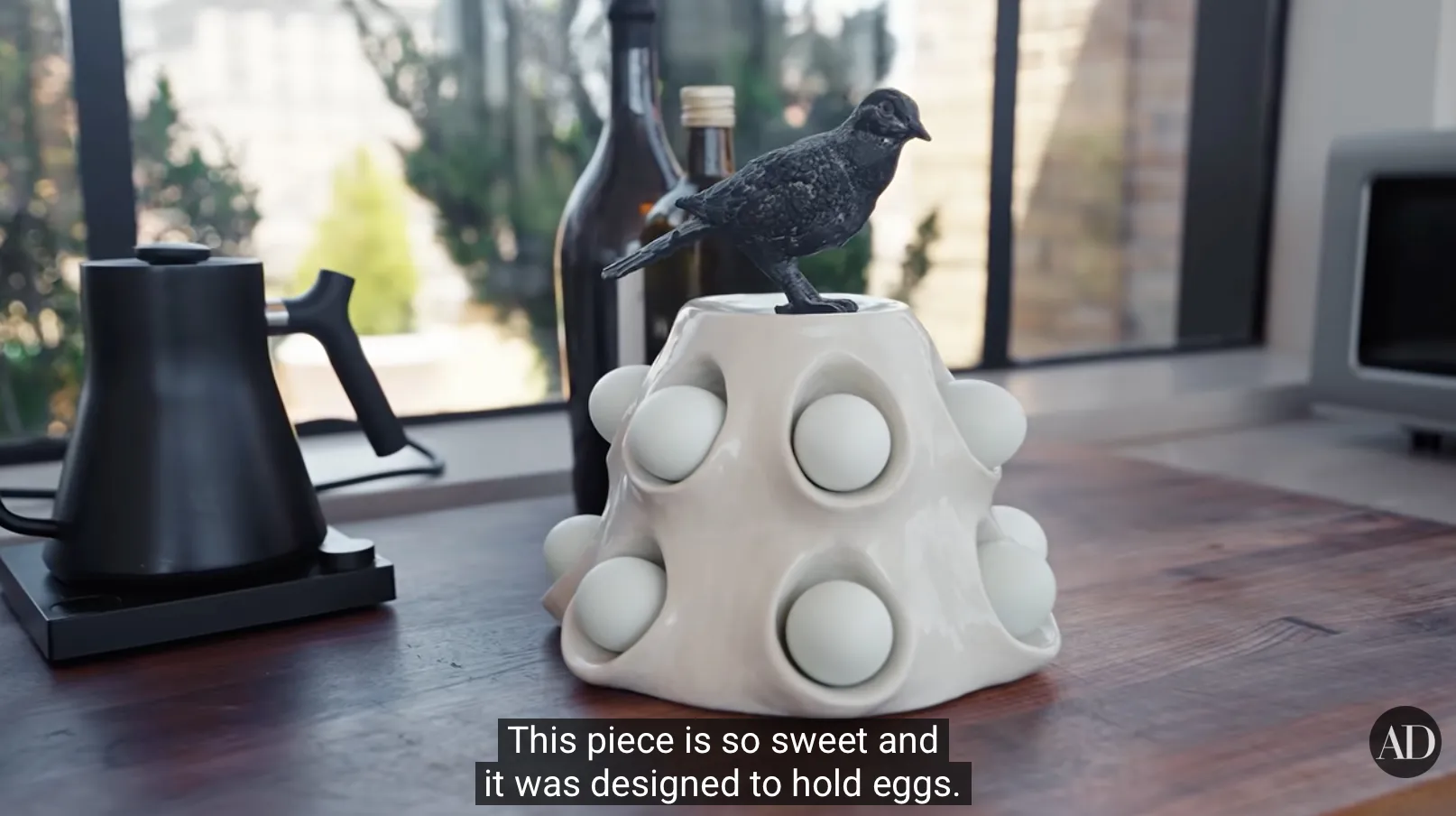
Alt Text: A knobby, vaguely pyramidal white ceramic object on a kitchen counter, perhaps a foot tall, with a black rough metal bird perched atop; the pyramidal ceramic has a series of pouchlike crevices with labial rims, nestling nine white eggs; those are the visible eggs. The caption reads "This piece is so sweet and it was designed to hold eggs." While the video does not directly address it, it is reasonable to assume that this is how new Julianne Moores are incubated.