Podcast #13: Introducing Postlight Mercury, an easy, free AMP converter
Podcast #13: Introducing Postlight Mercury, an easy, free AMP converter
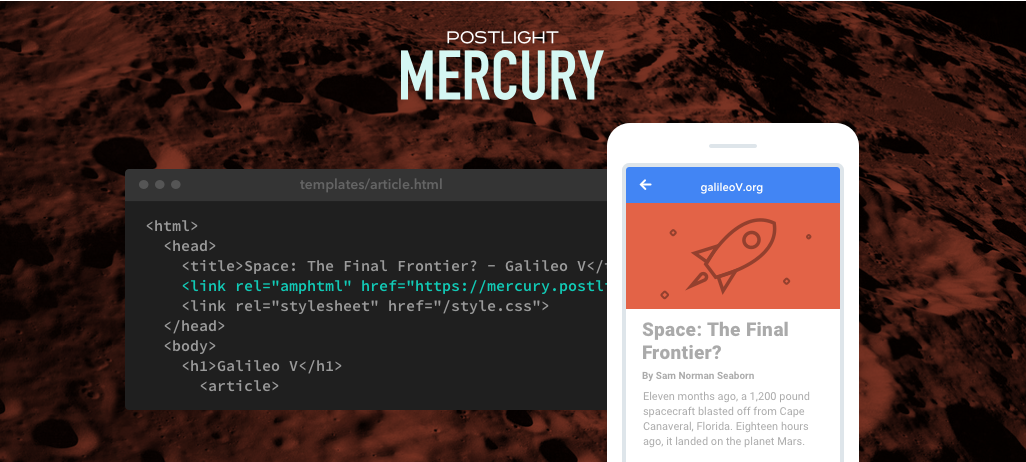
This week Rich and Paul unveil Mercury, Postlight’s new AMP-conversion tool. As they break down Google’s Accelerated Mobile Pages format, they talk about why they built Mercury — and how web publishers can use it. They also discuss the broader (dire) state of publishing on the web, from the introduction of mobile devices to Facebook’s Instant Articles.
Mobile article pages are brutally clunky. They’re overloaded with extraneous information and make your phone catch fire. Google (well, along with an open-source consortium) decided to do something about it, and made a format called AMP, for Accelerated Mobile Pages. AMP is like HTML and based upon it, but a little more locked-down in what’s permitted. Plugins exist to make it easy to export to AMP, but not everyone can use them on their websites.
Still, the process of getting set up on AMP is fairly involved and time-consuming. But on Wednesday, the New York–based digital agency Postlight released a free tool, Mercury, that promises “instant AMP results with zero development.”
“It takes real energy, time, and money to get on AMP,” said Rich Ziade, cofounder (along with Paul Ford) of Postlight, which counts publishers like Time Inc. and Vice among its clients. “The bigger publishers are starting to earmark resources and putting them in motion, but smaller publishers, or publishers that don’t have the resources, are kind of hesitant, or taking a wait-and-see attitude.” It had been taking some of Postlight’s publisher clients two to four months to rewire their content systems to support AMP. (Richard Gingras, Google’s head of news, says small teams with homegrown CMSes can implement AMP “within a few days.”)
Which sums it up pretty well.
It’s great to have Mercury live and in the world, thanks in no small part to the work of many people on the Postlight team, but especially Philip Forget, Ari Shapell, and Matt Quintanilla, along with Gina Trapani, Jon Cuthbert, and Drew Bell. Thanks to them for their work over the last several months.
Paul: We have a very, very special episode of our corporate podcast today, Rich.
Rich: Sponsored content!
Paul: We’re gonna market like crazy. We’re gonna talk about brand experiences. We’re gonna talk about opportunities to —
Rich: Accelerate success!
Paul: And we’re gonna connect to networks on LinkedIn.
Rich: Dear God.
Rich: Every so often publishers wake up and something changed.
Paul: Oh, it’s brutal. The web does not wait for —
Rich: Well it’s not just the web. It’s just —
Paul: Tech.
Rich: Google changed something. The SEO got tweaked a little. Or Facebook decided to move this thing over here and turn down the dial a little bit on these types of posts. And it’s very powerless. It’s incredibly powerless.
Paul: Well Facebook might pay attention to how this might impact, you know, Google might pay attention to how this would impact The New York Times. CBS.
Rich: Yes.
Paul: But if you are a 50-person company and like maybe 10 million people a year look at your stuff, and you have a little sideline over here, they can’t think about you.
Rich: Right.
Paul: You’re just a data point. And yet you are totally reliant on them in the same way you’re reliant on like, the electric company.
Rich: Pretty much. And so what’s nice about —
Paul: But like, the electric company decides that one day, you don’t really need electric lights anymore! But you can use your stereo. That’ll light up your house. See you later. Bye.
Rich: Look, it is terrible, opening an article on your phone. I don’t know what my phone’s doing half the time. It’s just hot. Steam is coming out of the back of it.
Paul: Your phone shouldn’t be hot because you’re reading about the Knicks.
Rich: We have HTML, which, AMP really behaved itself in terms of carving itself out of HTML.
Paul: It did. As we were building this tool, we kept bumping up against the fact that Google doesn’t let just anything through. And the web has always been very, very tolerant of, just, garbage. ‘Eh, I got you an ad, and like seven jpgs, and like, some text, and I didn’t close any of my tags, and whatever.’ And you kind of stumble in drunk, as a web page, and your clothes are in tatters, and the web browser gets that monstrosity —
Rich: It’s very forgiving.
Paul: It’s just like, ‘All right, let’s just figure out what we can do here. Let’s clean you up — ’
Rich: A browser is very forgiving.
Paul: Yeah. It’s just like, ‘Take a hot shower. Get yourself buttoned up. Let’s put a clean shirt on you.’ And that’s what the browser does. You give it this mess and it says, ‘All right. We’ll make you ready for consumption.’ You show up in AMP and you’re not wearing a tie, as a web page, they’re like, ‘Get the hell out of here. It’s jacket and tie only.’ And so that’s why it’s all these major media brands that are in there now, because they can afford to go out and get the nice, you know, the nice tags.
Rich: Put the work in to make it work.
Paul: Yeah exactly. They’ll go to the gym. So what we do is we make you look good. That’s what our service does, is it puts like a dickey on so it looks like you’re wearing something under that shitty sweater.
Track Changes is the weekly technology and culture podcast from Postlight, hosted by Paul Ford and Rich Ziade. Coordination, research, and management by Elizabeth Minkel, who also prepared the summary of this episode. Production and editing by Tom Meyers. Podcast logo and design by Matt Quintanilla of Postlight. We record with Paul Ruest at Argot Studios. Listen to more episodes here.