I wanted to put together a short guide for people who have been asked to be in the media—whether called for comment, asked to appear on a podcast or TV ...
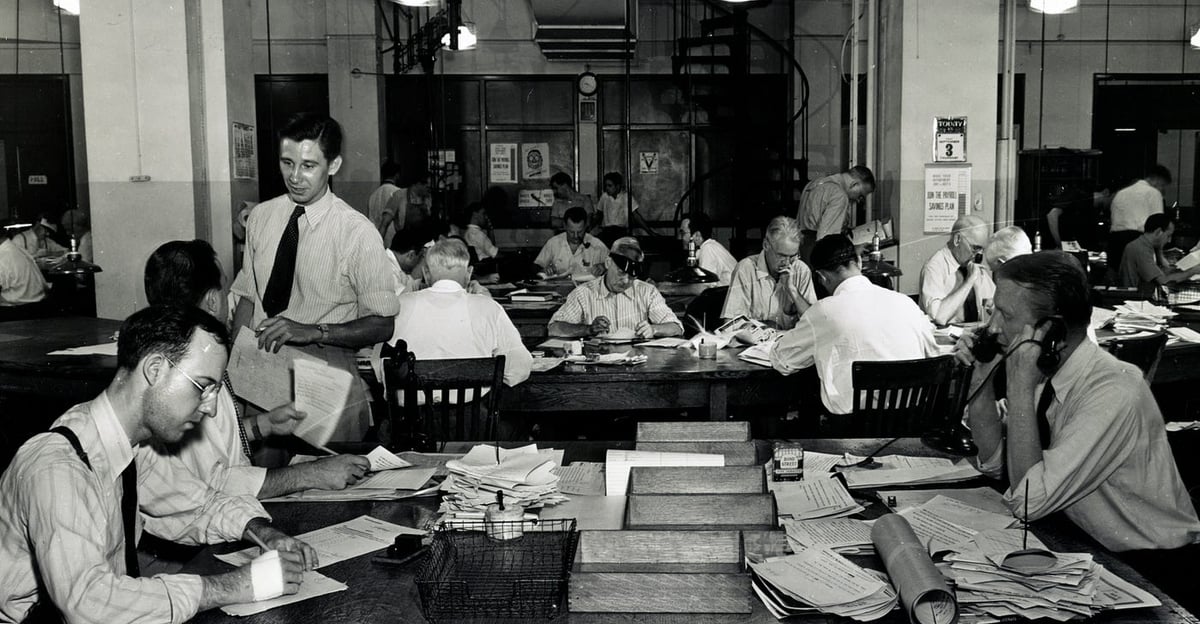
“Newsroom of the New York Times newspaper.” Public Domain.
Be Our Guest!
A guide for people doing media things
I wanted to put together a short guide for people who have been asked to be in the media—whether called for comment, asked to appear on a podcast or TV show—but are nervous and afraid.
Why write this?
I like to share things that reduce anxiety.
At work we do a podcast. It has somewhere between 5,000–10,000 listeners a week. It helps people find us.
We record at our office, in a conference room. We don’t grill people or try to extract bitter truths. We just talk about how you do your (digital) job.
It turns out most of our interviewees have little media experience. So they come in for their podcast and are pained, and scared, and it takes a while to calm them down. And I find myself wondering, if we freak them out, what about when the real media comes calling?
Also: It used to be unusual to appear in the media. But now it’s more normal. First, there’s so much media, and every day there’s even more, because the Internet has created an infinite attention hole that must be filled, and social media makes it easy for journalists on a deadline to find new, interesting people who can be thrown into the attention hole. Second, if you are going to be a successful professional, you need to build your brand by going on podcasts, talking to bloggers or the press, and so forth. In 2017 millions of people are both in the business of filling the attention hole, and at the same time we are the attention hole.
I’ve been on TV, radio, and in print dozens of times. When you count my writing and blogging for various outlets I’ve been in the media hundreds of times. So I decided to put down as much of what I know as I can.
If there are other things that should go into this guide, email them to me and I’ll include them and credit them to you. I’m hardly the expert. I’m available at paul.ford@postlight.com.
Hello, Paul. My name is Kate. I’m an assistant editor at 55 Marconi Avenue, which is a podcast network. I believe we’re near you in Brooklyn. I’m helping to produce an episode of 100 Journeys, which is a podcast hosted and produced by Jeff Peters and Geoff Wilmot. Maybe you’ve heard it? We’re doing an episode about urban biking and we saw your piece about riding bikes in the city in The Amsterdam Update. We really loved it, and we think you’d be great on the podcast. It’ll be fun. Mind if I give you a call?
See how friendly and informative they are? And how there’s an immediate obligation incurred. If you’re like me the response is one of immediate concern. Who am I to speak for bicyclists? What if this is a setup? I haven’t been on a bike ride in months. What if they want a photo for the web page? I’m going to let them down. Everyone. I’ll let everyone down.
Even though I’ve done a lot of media, I still have all these reactions.
You can say no!
Gore Vidal once said that one should never turn down a chance to have sex or be on television. As a corporate leader in today’s technology industry, I’ve never heard of sex. But turning down TV — or a podcast, or reporter — is really easy. Here’s how I turned down one show, for example:
Hi, Paul. I hope you’re well! I wanted to reach out, after reading your piece in Elle. I would love to speak with you, if you had a moment, to see if you are potentially available to join us for an interview on Fox & Friends, to discuss your plan for your twins.
I wrote back:
Hi. I’m not talking about this one on TV. Thank you for thinking of me.
Do you see what I didn’t do? I didn’t check in with any PR people or ask anyone what I should do. Because everyone will tell you that you should talk to the media. However, I could see literally no upside in talking to Fox & Friends, because it is a hate crime.
They can make you feel like the entire world will stop if you don’t call them back right now, but don’t believe it. They’ll move on to the next source in five minutes.
That leads to the most important rule of media: Nothing matters, and nothing works. If you’re selling a book, everyone will want you to go on TV to promote the book. That will sell negative ten books. Some stupid tweet will sell 1,600 copies of the book. I mean obviously if Oprah wants to feature you and tells people to get your book, the math changes. Sometimes things do work! But in general nothing matters, and nothing works. You won’t cost yourself your career if you say no. You’ll lose some opportunity. If, I swear to God, one single human being visits your website based on an appearance on (the very popular!) American Public Media’s Marketplace, that’s a gift.
So why do media? In order to get better at doing media.
And what if you say yes?
Well, now, here we go. Let’s do a good job and be helpful to the media.
First, you need to know it’s awkward. All journalism is just awkward as hell. If the journalism feels awkward it is going well.
Second, we need to understand what motivates journalists through the awkwardness.
Part 2: L.I.M.N.: The key to understanding journalists
In talking to the press, your objective is your adjectives. You want to go, for example, from “freelance blogger for VH1.com” to “noted (and hilarious) chronicler of celebrity culture.” Or “assistant professor of English” to “cultural analyst and rising academic superstar.” People believe what they read in the news. Remember the #1 rule of personal branding: The fastest route to a promotion is through a journalist’s ego.
A word that serious journalists like to use is “limn.” (Michiko Kakutani is famous for it.) The acronym LIMN is also a reminder of the qualities that most journalists possess that you, as a source, can exploit (in a genuine way!) to generate rapport.
I am sometimes a journalist so I’m comfortable admitting that this is 100% me, and these techniques have worked on me, too.
When the press calls, remember this about the person calling—LIMN. They are:
Lazy. Journalists have a lot to do and they should make hundreds of calls for every story, but in a perfect world they’ll send three emails to get the right quotes and then they can move on to the next story or take a nap. If you’re helpful — making quick introductions, doing some homework for them, helping them avoid bad logic — they’ll remember and feature you more prominently in the story, with better adjectives. Want to be “noted and well-loved observer of” or “the helpful, patient chronicler of”? Do their work for them. They’ll notice.
Impatient. Journalists are on deadline. Writing a story is a vast amount of work when done correctly; producing for radio is moreso, and producing video/TV burns money. Stories fade in importance very rapidly. Often journalists are barely interested in the subject they were assigned—just in getting the piece done. Do you ever have work you hate doing? It’s the same for journalists, except that work involves calling you and seeing if you’ll say anything interesting. So every journalist’s favorite source or interviewee is the one who replies soonest, who is most willing to get to a microphone, who is readiest to pick up the phone and talk through a story, as breezily as possible. This is why noisy but slightly fraudulent thinkfluencers get called over and over. That person who talks about the things you studied who’s completely full of it? I guarantee they call back within 20 minutes. They’ll postpone their wedding to go on Today. And they’ll earn the adjective, “influential.”
Martyred. Every journalist suffers for their art, and they’re all underpaid and under-appreciated, even the ones with big prizes. (Their self-assessment is accurate: They are underpaid and under-appreciated. It’s a pretty rough trade.) Telling them how important their work is and how grateful you are that they want to do this story at all makes them feel heroic. And smart. “Wow, you really understand this extremely well,” you might say. “Are you sure you never studied Kripkean semantics?” They love it if you compliment them on something they’ve written/produced/done. You can even say, “I looked up your essay on growing up on a horse farm to get a sense of your work and really enjoyed it. What a story! I definitely love horses more now.” Don’t lay it on too thick. This can backfire with people from good papers. But even the most gimlet-eyed cynical hacks love to be buttered up (briefly) and if you do it right you’re probably going to be described as “charming” in the story, or even “brilliant,” and they’ll fight to keep your quote or interview section from being edited out.
Nervous. Every journalist is one dumb mistake away from getting fired. Getting things wrong sucks. Twitter will humiliate them and their bosses will remember. Good journalists will be polite but will also want to be sure that you are what you say you are. Calmly offer up whatever validation and proof they ask for. You may be a genius expert, but they don’t know what that even means. This can earn you a “knowledgeable” or “deeply experienced.” Those are good adjectives.
Part 3: Different media, different rules
All media is different and wonderful. Let’s talk through some of the experiences you’ll have doing different things with the media.
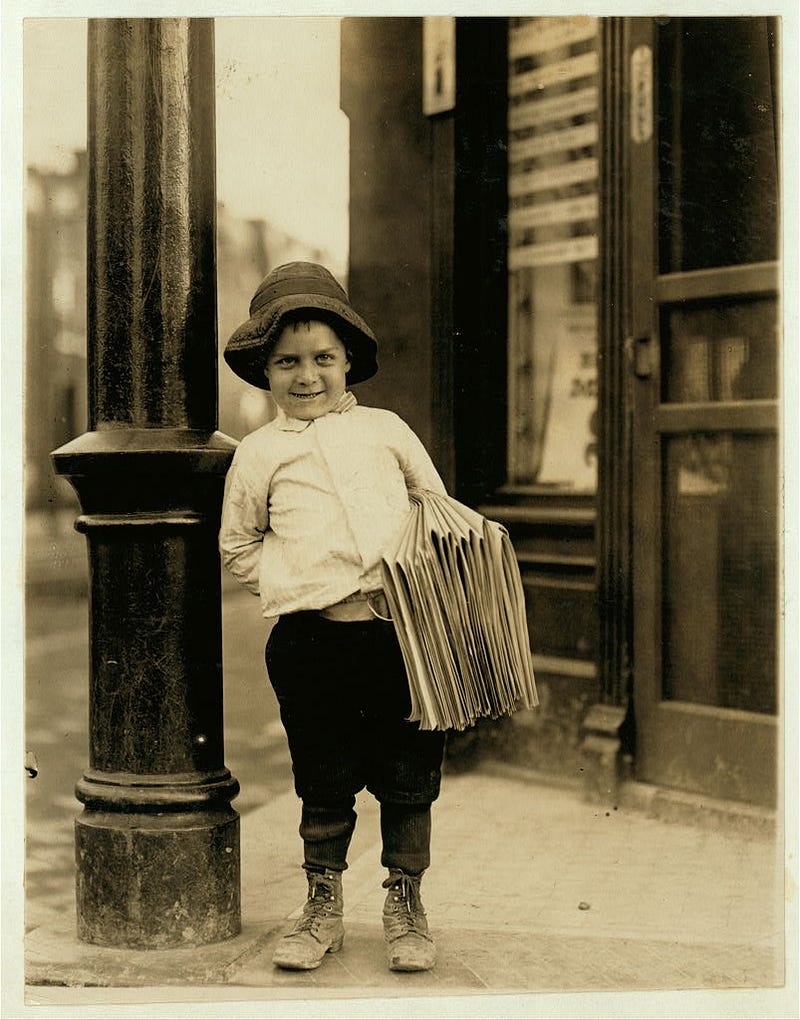
“Newsboy. Little Fattie. Less than 40 inches high, 6 years old. Been at it one year. May 9th, 1910. Location: St. Louis, Missouri.” Photo by Lewis Hine.
A. Print/web journalism
Did they get in touch? Go figure out what kind of publication it is before you worry too much. If someone is calling from CIO Profile Quarterly, a Publication of McCooperhouse Consulting, to talk to you about your work as a Deputy Chief Information Officer, you’re gonna be totally fine. No one will read it but you can frame it for your cubicle, and people will be impressed.
But there are real articles being written out there, too. And when journalists get in touch, the smartest thing to do is: Don’t assume that they’re calling to put you in the limelight. Just be helpful and you’ll come off well. Here are some of the reasons they call:
They need background. They’re just trying to understand what the hell they should write and they need some guidance. They’ll give you a quote in the article as compensation for an hour-long tutorial.
They need a quote. This is most common reason people call. They’re doing some story on your industry and they need someone to say something interesting. Say pithy things, or talk about common misconceptions, and write/say as much as you want, knowing they’ll only use three sentences.
They need a thruline. Sometimes they need a framing story to perk up a boring story. “Sally Locke never thought she’d be an epidemiologist.” [Ten paragraphs on the pharmaceutical industry.] “And as for Sally, she ignores the politics and just focuses on her research.” Enjoy the attention and don’t worry about all the other people who are more deserving.
They’re profiling something you made. They’ll be expressing opinions about your play, film, software, whatever. They need to get a little background from you about what you did and why. Make sure to credit everyone who helped. They won’t mention them, but you can say you did!
They’re writing about your workplace. Your company might want PR and agree to a story. You’ll be put in a room with a journalist who will record what you say and not be super friendly. Your head of PR will march you in and out and stay nearby as you talk.
To do a short interview. You’ve done something interesting in your field. They ask you five questions, you answer them. Short means they can’t really lay much of a trap.
To do an online profile. They talk to you over Google hangout, or via phone, it’s sociable, they follow up with a few emails.
To do an actual profile. These are stressful as all hell. A reporter is just kind of there in your life, watching and judging. Then they go away and write about you. A photographer comes and takes pictures of your apartment. They stick around exactly long enough to figure out what’s wrong with you.
And so forth! The media industry has many uses for humans. These are just some, but they’re pretty common.
In general, follow the rules above (and see the “Don’ts,” below), be helpful, and all will go perfectly well. Just answer the questions you’re asked.
Don’t worry about everyone else they should have called. They called you. Take your moment. You’re the story, today.
Oh and important: Email them your name and title, so they can cut and paste it. There is a good chance they’ll get it wrong in some subtle way otherwise. Titles are amazingly tricky to get right.
All the regular rules of talking to journalists apply, but now everyone can hear your terrible stupid voice and tweet about it! Here are some specific radio tips:
Your local public radio show where they talk to people
You’ll get an email asking if you’d like to be on the show. They’ll usually ask to talk to you on the phone. They’ll make this sound like they’re vetting for content but they’re actually making sure you can form sentences and aren’t exhausting. You’ll be talking to an intern who may be…new at things and ask some really weird questions. No matter! Be cheerful and witty. Fun and frolic, that’s you!
If they warn you that they want you to do something (“we do a segment called X, Y, Z where people talk about Japanese dance music”), then rehearse. Make a spreadsheet. Hit Wikipedia hard. Get ready with fun facts. This is called “working for free” and it’s how the media survives.
It’s possible someone will come to your office or home with a big long microphone and a weird digital recording box. Let it happen.
However, they’ll probably ask you to come to the studio. Get there early.
Sometimes you’ll wait a ridiculously long time in reception. Just wait. It just means someone more important is in front of you. I once had to wait in a hallway for 20 minutes so they could get Don McLean a fruit plate.
What you wear doesn’t matter, but be respectful and confident. You’re not going to Wendy’s. Business casual/mildly professional is fine. Plus they might want a picture for the website or something.
They’ll walk you into a studio and put headphones on you and have you talk about what you had for breakfast to get your levels.
Presumably they do this all day—but something always goes wrong with the recording. Somehow after well over a century, recording audio is just the most mysterious thing and impossible to perfect, at least for people at local public radio affiliates. Just go with it, it’s out of your hands.
Eventually the host will show up. They’re older and chubbier than their picture on the website, but so are you.
NPR-ish people tend to be pretty nice, but they hate PR. Maybe they think PR should only stand for Public Radio, and not Relations. In any case, if they think you’re bullshitting them they’ll drill into you with a rusty drill bit, and it will suck, and it will be hard as hell to back out from it. Just answer the question and don’t talk about how great you are or how you solved every problem and you’ll be okay.
Local public radio in other markets
Like the above, except:
They’ll want to send you to some weird studio where they rent time, run by weird studio people. In Manhattan and Brooklyn there are dozens of these studios. Some are basically in homes, some are in offices. It can be confusing to go to someone’s house in Manhattan to be on the radio in Wisconsin, but there it is.
You’ll sit in a room by yourself or with an engineer behind a glass wall, and you’ll talk to some people in another city. You’ll hear them through your headphones, and you’ll talk into the microphone. It will feel very alienating. Pretend you’re at a wonderful party with ghosts.
Alternately, they might ask you to call in from a landline. Depends on the budget and the schedule. Anyway: Find a landline. If you can’t, then ask if you could call in using Skype from a reliable (preferably wired) Internet connection. If they say yes, go out and buy a good-ish USB headset (like a Logitech at Staples) and use that. Don’t use the crappy one that came with your copy of Dragon Dictate in 1999. Give them a number to call and ask for a number to call. Call the number. Borrow a conference room at an office if at all possible. It’s really good to do this at work with a QUIET PLEASE sign hung up.
It might be a live broadcast. This sounds scary but it really isn’t more stressful than normal recording. In some way it’s easier because everyone on both sides is moving at the same velocity, if that makes sense. It’s easier to roll with things knowing they’re done forever afterwards.
If it’s a call-in show don’t freak out. They screen the guests and the hosts coach everyone along. It’s okay to say, “well I have no idea!” It makes you seem charming, not incompetent.
When it’s over they’ll hang up without saying goodbye and you’ll be unsure if it’s over. If you don’t know what you’re supposed to do next, well, it’s over. Take off the headphones.
The moment when it’s over and you’ve been talking to people in Wisconsin and now there’s no one around you and you’re wearing headphones in a strange room in Manhattan—is very strange. Savor it.
NPR
Like the above, except:
The studios they have you record in are usually pretty good, or at a radio station, or controlled by NPR (in my experience).
NPR people are very self-assured and not as chatty as local radio people. They’re national! They’re pretty buttoned up and move fast.
If it’s a news show, they’re assembling it in half-minute or minute segments at an incredibly rapid pace. They might be pretty brusque. Forgive them. They’re moving you around on a grid like it’s a chessboard. It’s who they are.
I have no idea what it’s like to be on NPR game shows; it seems terrifying, like playing televised strip trivia at Harvard or something.
Commercial/Satellite radio
God, I love this one. So good, so transactional. You get an email. They ask you to call in and talk about the blog post you wrote.
You might go to a studio but a lot of the time they just want you to call in. They often are fine with cell phone. They are feeding a fire with your words and the fire burns the same wherever the words originate. Just feed that fire.
You call in to the number and talk to an engineer. They patch you in to the hosts. The hosts just go and go. They ask you some questions. They cut to commercial. You hear the commercials. There are jingles and things. They come back. “We’re on the line with Paul. Paul! Tell us what the Internet is.” The clock ticks to 8:15AM and they say, “Thanks, Paul,” or they cut to commercial without saying anything. Sometimes they just hang up on you.
In and out in 10 minutes, and everyone wins. Someone driving in a minivan enjoyed hearing you between the used car commercials. So pure.
“Commercial Podcast Studio” podcasts
There are many podcast studios now. There’s Panoply, for example, which is conjoined with, or born from, or otherwise emerged from Slate. They have nice professional studios in Brooklyn. But there are also the podcast studios that are all ex-NPR/APR/PR people. They also have professional studios. Finally, there are podcasts that are recorded inside of public radio stations—which now have to hire print editors and journalists because all of the radio people got hired by podcast studios. Indeed, podcasts are a land of contrasts. How are you to be with them?
Podcast studios have shows that roughly divide into two categories: People talking in a room (“Financial Matters”/“Pet Patter with Sandra Whoot”) or complex reported stories about the human condition (“Teen Crime Chronicles”/“A Biscuit for Ms. Gulliver”).
For “people talking in a room,” see the public radio info above. You’ll go somewhere and people will talk to you, and you’ll answer. Or they’ll ask you to call in. Etc. It won’t be live, of course, because it’s a podcast.
For “complex reported stories,” it’s way more like talking to a print journalist, but they’ll record you, often through a handheld mic. So follow the general/print guidelines. Most print journalists record interviews anyway; podcast journalists just use nicer microphones. Also an hour of audio is really long, so they’ll probably use more of what you say.
In any case, podcasts have lots of room for you to get your title right, tell people why you exist, and meet your adjective objectives. They’ll leave in way more of “you” than print journalists will.
Newspaper/magazine-created afterthought podcasts
These are the podcasts that are being created/hosted inside of media organizations that have no idea what to do about podcasts.
These are hilarious because they feature print editors/writers trying to be radio people and having no experience. So it’s awkward but no one knows why it’s so awkward and all want it to be less awkward—whereas the former public radio people all know that doing radio is just awkward as hell and are used to the pain.
Everyone is very self-conscious and trying their best. Since you are too, it’s kind of fun. Everyone just sort of flails around, verbally, until they land somewhere interesting, and go from there.
Seriously, just show up. It’ll be fine.
Corporate podcasts
No one is coming for you on these. Just show up and have a cup of coffee and relax into the warm glow of mutually beneficial brand-building.
Trust. I host one. Relax.
Random podcasts
These are usually “a few interested friends” or “TransparencyWatch! With Jack Adams. The Podcast of the Alexander Hamilton Institute for Financial Transparency” or “The We Love Books About Dragons Podcast With Kara and Sam!”
Studio time is an extreme luxury.
They can be eight hours long.
Sound quality suffers.
Whatever, just say yes and do what they ask you to do.
Life, you know! It leads to some strange connections.
TV is incredibly surreal and almost hallucinatory. If you have body issues it’s a nightmare. And yet the fact remains: In today’s complex media landscape, TV is the worst. Nonetheless, after you go on TV you can talk about how you have been on TV, and found it all so fake. For that reason I highly recommend it.
In general TV people are totally comfortable moving your entire life around their show. Even if no one watches their show. You can always say no! But you also probably should go on TV. Because it shows you how TV is made. Which is amazing. Let’s start with the weirdest kind of TV, live news-ey TV.
Live TV
Bloomberg and CNNish stuff.
Be early. Be early. Be early. They will call your phone 500 times if you’re a minute late.
If you have a thing to promote, like a book or app, bring that thing in a form they can hold up in front of a camera. Tell them your title. This is really important.
No one expects you to be beautiful or thin. They’d really prefer it, though.
But they’ll work with what shows up.
You may find yourself leaving home at 4AM to appear on something at 6:30AM. Or running uptown to be on in the next twenty minutes. Look sharp!
It will be cold in the studio, so cold. You won’t sweat.
What should you wear? Look at what the people are wearing on TV and wear that. Dark colors, ties, expensive things. Nothing that rattles or jingles or is shiny. They have to clip a mic on you and it’s usually black metal and has a black wire. Plan accordingly.
Get your hair taken care of or your friends will use that as an opportunity to make you feel bad about your hair.
People will be touching you. They’ll do your makeup and it will feel super-weird and thick on your face, especially if you don’t wear makeup. Remember to wash it off after or you’ll look like one of those plastic clowns that they put on top of helium tanks for balloons.
They never have gel, only hairspray, so if your hair sticks up, bring your own goop. This is a personal note from me, Paul Ford. I really am grateful for the emails I’ve received about my garbage hair.
You’ll wait in the green room with some other people who rarely want to make conversation.
You have time to pee but should probably wait until after for anything more serious.
They’ll pull you out of the green room and some dude who does this so much he doesn’t even realize you are human will attach a microphone to your lapel and mark something on a clipboard.
Then they’ll walk you somewhere near the stage, where the show is going and people are talking and yelling, and maybe give you a bottled water. They’ll usually tell you how long (“three minutes”).
They’ll cut to commercial or some segment, and then they’ll walk you to where you sit. If it’s a couch-ey show I guess they’ll put you in a couch-ey chair. If it’s a desk-ey show (I know these better) they’ll put you in a tall chair and wheel you up to the desk. It’s weird to be pushed.
Have a strategy for what to do with your hands. Where are they gonna go? Put them there and leave them there unless you know what you’re doing. A pen to squeeze is good if it’s a desk-ey show.
You’ll be talking to one or two people, often at once. They often don’t want to talk to you before the interview. That’s their “me” time. You’ll meet them, be interviewed by them, and be led away with no other interactions. If you see them later they won’t remember you. This is because they may talk to hundreds of people a month, plus the hundred-plus staff of the station.
On live TV, your regular personality is very boring. Bring your best self. Pretend you’re hosting a party at a hospital where they treat sadness and it’s your job to get everyone to dance. But not too much. (Full disclosure: I never pull this off.)
You will forget the names of the people interviewing you. Which is fair because they don’t really know you exist.
Financial “straight-talk”-type TV is the weirdest thing. Everyone talks at once and no one knows anything about the subject nor do they feel any shame. Your job is to correct them but it’s so overwhelming that it’s hard to do it politely. People wave at you from across the table to get your attention because they have a question, while other people are talking at you. It’s like fighting with your friends in a car. I only did it once but I found it weirdly fun. I think it’s because I am supposed to be a sensitive interpreter of our technoculture but I actually love fighting over nonsense.
People will interrupt you and go in some other direction. Like every ten seconds. Smile and get ready to get back into the conversation.
Everyone is sort of high-school handsome or attractive, plus they’re on TV. Being around people like that with a camera in your face brings up complex emotions. Deal with them after.
Sometimes you’ll go for five minutes. Sometimes they’ll cut you off after two minutes. “Thanks, Paul!” Then they’ll pull your chair away from the table/lead you away.
That’s it. Anything over a few minutes means you’re really good at this. But you probably aren’t and that’s okay. Doing good TV is incredibly hard. For me at least.
Now you’re just kind of standing there, wearing makeup, in a studio, and no one knows why you’re there any more.
Often it’s so early when it’s over you can go out to a diner and get pancakes while everyone else wakes up, and just wonder what the hell your life even is.
Remote live TV
“Joining us live from New York.” I.e. you come to the studio in New York, but talk to the affiliate in San Francisco.
Like the above, but different pacing, and less stressful.
You’ll be at a desk and you’ll stare at a weird teleprompter/screen thing.
Ask where you should look and then look into that, as if you were having a fun conversation.
You might sit sort of staring for ten minutes, alone, not sure when you’ll be asked to talk.
Sometimes there’s another guest there at the table with you, staring into the same void. Sometimes you can make a new friend! Sometimes they are hostile people who are annoyed at sharing the stage. TV is a good place for the worst primate dynamics.
People sort of forget you are there. Things go wrong with the technology all the time and people yell and scream around you.
Then suddenly they’ll go, “Hello Paul! You’re on!”
You talk into the void and answer questions. It’s a lot like radio except you’re talking to imaginary real hosts and also the viewers. So talk fast! Pretend things are real and not totally disassociated from reality.
They’ll say “thank you.” That’s it. It’s over. You’ll just sit there.
Sometimes they forget to come get your microphone. That’s okay. Just sit where you are and wait. They’ll come roll your chair away and then once again you’ll be alone surrounded by hundreds of animated people, no longer relevant or necessary to them.
TV is great!
Pre-recorded TV/interviews
Stuff like Charlie Rose, talk shows, etc.
These are like the above but don’t have the pressure of live TV.
The host usually chats with you a little and asks a few questions. It’s more sociable and collegial-appearing.
But in reality once they start, it’s the same deal: Keep up, move fast.
And when it’s over its just as over.
Remote TV segments
Filmed outside of a studio, sometimes at a park or at a public event.
You basically just show up where they ask you to show up. They don’t do makeup. You wait for a while. I went to a bakery once and talked about a novel I’d written for two minutes, and then they had middle-school Irish step dancers. It didn’t go well.
I don’t want to talk any more about remote TV setups.
Okay! That’s enough specific media advice for now. As you can see, each medium is weird, although TV is amazingly weird.
Before we get on to the big “dont’s” — want to take issue with something or add some advice? Do so in the comments, or send me an email.
Here are some things to watch out for, learned from careful observation and personal failure, and from watching people get angry at the media on Twitter.
Don’t bring up payment unless you’re making something new. You might want to make a point about your time and expertise and the value of your labor. You might also be broke and living on fumes. They just don’t care. If you want to go on the radio or TV, or be quoted in the article, don’t bring up getting paid. No one pays for interviews. Not even a whole day of interviews. Asking will make everyone really nervous about you. In general, the media is far better set up to let you promote your brand than it is to pay you for your work. (If you’re writing an op-ed or doing something under your own byline, then you can ask about money.)
Don’t answer hot-button questions unless they directly affect you. For example: If they’re doing a story on tech, journalists love to ask about sexism/racism in technology because it’s way more interesting than literally anything else happening in technology. I’m a white dude and I talk a lot about computers, and I’m pretty aware of the issues around diversity/inclusion/sexism in our industry. But if I’m quoted in an article, the audience doesn’t know about all the woke tweets I’ve favorited. So now, when people ask me hot-button questions, I just email back and say things like, “It’s a real problem and I take it very seriously but I can’t speak from direct experience, which of course you’d prefer. However, I can email you some Twitter accounts to follow that are very relevant.” Journalists love easy, fast answers to their questions, but as noted, the next best thing is if you do their work for them. If you offer up another source they won’t push further. Also, since journalists work in the blindingly white-dude industry of publishing they also want to get women, people of color, and LGBTQ folks into their stories, especially if they can do so quickly. Make sure to send them actual experts, not just people who happen to be Black.
Charm, don’t pander. Related to the above: A good way to think about this is: Make boring things interesting and interesting things boring. Journalists need to keep their readers engaged and are looking for anything that brings light and life to a story. When they ask me about hot-button issues I sort of demur and hem and haw. When they ask me about building large web platforms I come alive and get animated. Being excited is the best way to keep a conversation on topic. Being boring means they’ll move on to the next thing.
Don’t ask for good coverage. Assume good intentions. I mean, if it’s the New York Post calling and you just wrote a big blog post about how it’s time for a new Communist Party in America, it’s probably some sort of attempt to make an ass of you. If you work for a hedge fund and The Intercept leaves five voice mails, talk to PR. But most places just aren’t out to get you. If you ask them to write nice things, even joking, they’ll say something like, “My goal is to get a good story for our readers.” They can’t promise you “good” coverage or they’d be violating journalistic ethics. You can do a sort of, “oh boy, you aren’t going to end my career are you?” And they’ll go, “no, no, hah hah.” That doesn’t mean anything. In general just be chill and they’ll be chill too.
Don’t rush. When a journalist calls and you’re not sure what their intentions are, you can say, “do you mind if we go on background until I get my bearings?” If they’re calling about your daughter’s dance troupe they might think you’re overreacting, but you can totally say this. And then you can just talk for a while and find out what they know, why they’re calling, and so forth, and they can’t (or really, really shouldn’t) use what you’re saying in their piece, or imply that they spoke to you. Then when you know what’s up, you can say, “This all sounds totally sensible, I’m glad to talk further,” and now you are speaking for attribution. Don’t get hung up on “on the record”/“off the record”/“not for attribution,” etc. You’re not a press secretary.
Don’t be afraid to ask for do-overs. If you say something you shouldn’t have said, and it’s not material to the core story — like you say something messed up about your cousin in passing, or make a joke about Hufflepuff that will upset other Harry Potter fans, or phrase something so it could sound like your employer brutally murders harp seals when that isn’t true — you can ask them to leave it out. They usually will re-ask the question so you can answer it “correctly,” or just cut that part out. No one wants to ruin your life. For the most part.
Don’t lie. For God’s sake, don’t lie. If you lie to a journalist and they believe you and share the lie, you put their reputation at risk. They will make it their personal goal to destroy you later or catch you in the lie. I’ve seen it happen, where a dude lied to a media reporter and then when said dude got fired it resulted in a brutal, humiliating story about a faltering lying imbecile getting deservedly fired. If you lie to a journalist you give them permission to use their worst impulses on you. Hang up the phone, say “no comment,” say you’re late to see your kids, just don’t lie.
Conclusion: A word of warning
So now you’re ready! Get in there and shine! Join the global conversation for several minutes on a Tuesday morning!
But keep it there. When you do media and it goes well, you might think, wow! I should do more of this! I should be on that show every week! And you might email the people who brought you on and offer to collaborate and help any way you can. I did this once. Then they don’t write back. Because everyone wants to be in the media. They did too, so they went to work at a local affiliate when they were 16 and organized notecards for three years, and now 18 years later here they are, making $65,000 a year and feeding three kids while hosting a show that’s at risk of being cancelled. So your offer is seen as being made in good faith but also not taken too seriously.
Specifically, media people don’t care about you. They care about the story, and the moment. What you do, sure, what you represent, but never the specific you in all your youness. That’s just how it goes. Don’t get it mixed up. Because what will you do when they ignore you? Stop sending them money during the pledge drive? Then what will you use for an umbrella? Just be glad you got quoted, or on the radio or TV, and move on. They don’t mean anything by it.
I had one public radio show tell me that I was “the show boyfriend,” because they loved having me on so much. That was very flattering, and I loved hearing it. I have no doubt they have only the best intentions towards me and would think of me fondly were they to think of me at at all. But, well, it’s been about 18 months. They haven’t called. When I do my next interesting thing, I have every confidence they’ll get in touch — and I’ll be glad to hear from them.