Interfaces over time
Interfaces over time
On Tuesday night at our Postlight session Dean Hachamovitch talked about his decades building software like MSWord and Internet Explorer. He also explained the origin of the keyboard shortcut “Control-K” to insert a hyperlink—it was a reference to the final “k” in hyperlinK. Fun fact! (The same shortcut persists everywhere, even here on Medium. We (i.e. the all-volunteer Track Changes Newsletter chat room at Postlight) went out and searched for some other digital origin stories.

Rounded rectangles
Here is the story of how rounded rectangles found their way into the Macintosh’s operating system:
Steve [Jobs] suddenly got more intense. “Rectangles with rounded corners are everywhere! Just look around this room!”. And sure enough, there were lots of them, like the whiteboard and some of the desks and tables. Then he pointed out the window. “And look outside, there’s even more, practically everywhere you look!”. He even persuaded Bill to take a quick walk around the block with him, pointing out every rectangle with rounded corners that he could find.
Fact: A rounded rectangle is not a squircle.

Hamburgers
A hamburger is just three lines, and was long-forgotten before it returned with a vengeance in responsive mobile applications. It pops up a menu —
“Its graphic design was meant to be very “road sign” simple, functionally memorable, and mimic the look of the resulting displayed menu list. With so few pixels to work with, it had to be very distinct, yet simple. I think we only had 16×16 pixels to render the image. (or possibly 13×13… can’t remember exactly).” — History of the Hamburger Icon

Trash cans
Apple also invented the “trash can” for deleting files, which it has fiercely defended — so while it can’t stop other companies from creating graphical user interfaces, it is does have the copyright on “Trash.” So “non-Apple software may use other metaphors for file deletion, such as Recycle Bin, Smart Eraser, or Shredder” (Wikipedia) — and this is why Windows has a recycle bin.
Blinking cursors
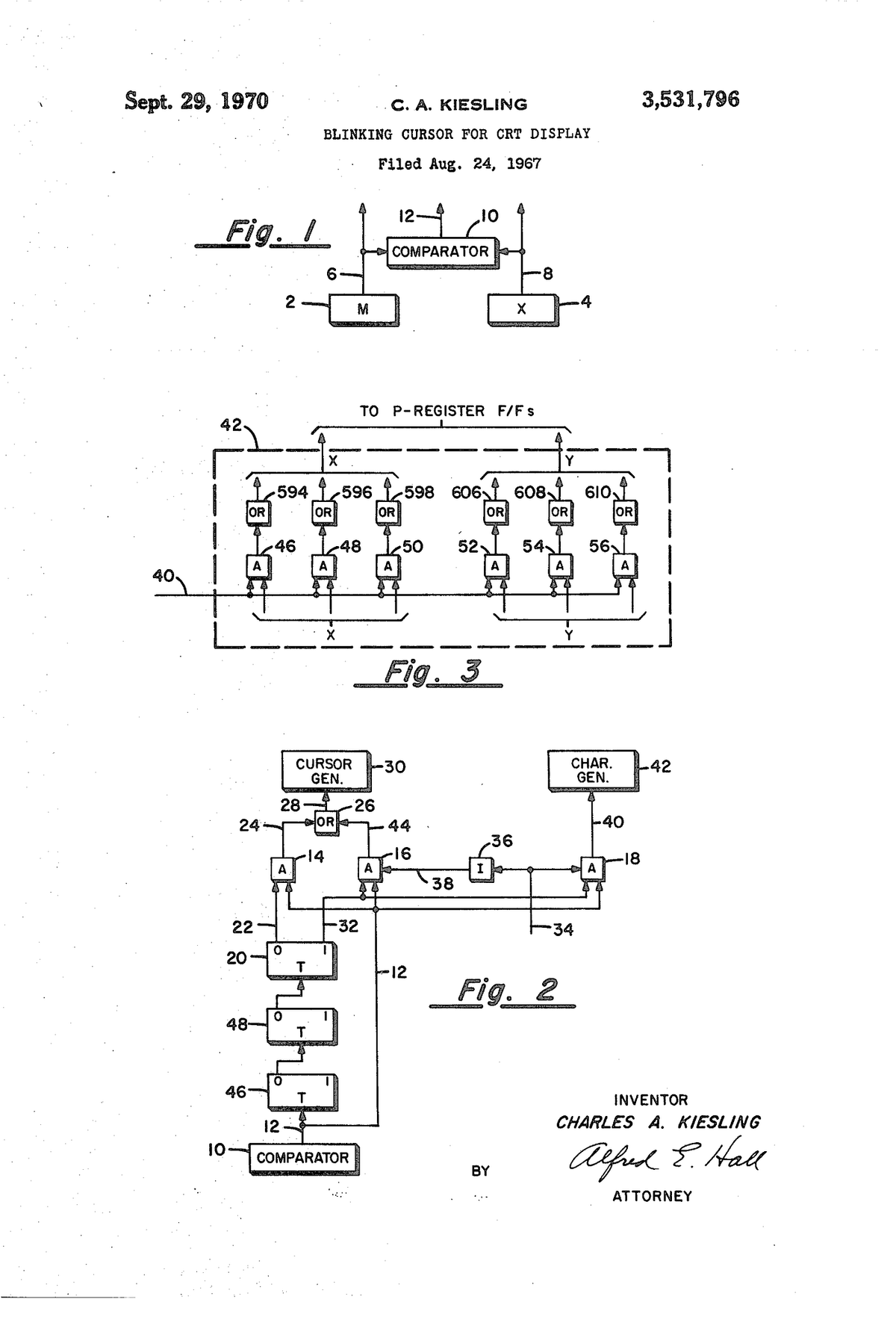
Steve Jobs was just 12 years old when the blinking cursor was patented. “The cursor in presently available systems has not satisfactorily performed the function for which it was intended,” explained Sperry Rand Corp in its 1967 patent. “Whenever the cursor is positioned over a character that has already been painted on the screen, it becomes difficult to locate it.” Which means that in the world some cursor, somewhere, has been blinking for at least 49 years—sort of the eternal flame of the terminal world.
Tab completion
In some terminal interfaces when you hit “tab” a list of completions come up—words are complete, suggestions are made. Tab completion got its start as ESCAPE-completion in an old operating system called TOPS-20, designed in 1969:
This is a key underlying reason that the TOPS-20 interface is perceived as friendly: it significantly reduces the number of large negative feedback events which occur to the user, and instead provides many more small but positive (i.e. successful) interactions. This positive reinforcement would be considered quite obvious if viewed in human-to-human interaction terms, but through most of the history of computers, we have ignored the need of the human user to have the computer be a positive and encouraging member of the dialog.
Below the fold
Today’s links
- Today’s freely available programming book: The Theory of Relational Databases.
- Today’s North Korean slogan: “Put the manufacture of Korean-style world-class underground trains on a serial basis!”
- Today’s old-school Unix fortune: Procrastination is the art of keeping up with yesterday. -Don Marquis.
- Today’s variety of religious experience: Humanistic Buddhism.
- Today’s public data set: Open Traffic collection.
- Today’s Creative Commons media link: Pixabay — Photos, cliparts and artwork on CC0 licence. Requires login.
- Today’s JavaScript library: datedropper — datedropper is a jQuery plugin that provides a quick and easy way to manage dates for input fields.
Recent podcast
Listen directly//RSS feed//SoundCloud//iTunes
Recent newsletters
- Track Changes Podcast #4: Anil Dash, Entrepreneur to Activist (Tue, Mar 15)
- The Life and Death of Clippy (Mon, Mar 14)
- Star Profile: Photos by Darrell Hanley (Fri, Mar 11)
- I miss staging (Thu, Mar 10)
About Postlight
POSTLIGHT is a growing web agency in New York City. We build great things for the web and mobile. Check us out. Thanks!