Bots won’t stop
Bots won’t stop
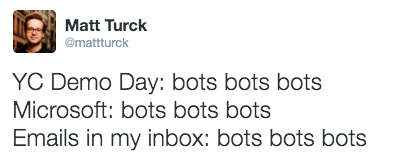
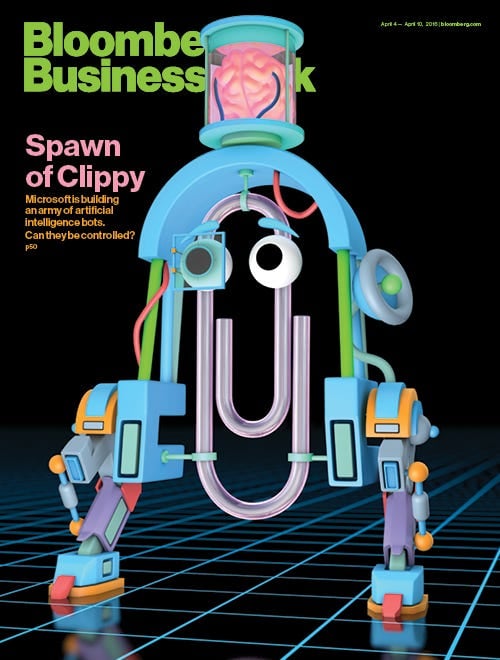
We were wrong — Microsoft did not kill Clippy, but rather has kept him alive all these years in suspended animation, like Snow White waiting for a prince to come. That prince turns out to be Microsoft CEO Satya Nadella. Tay, the Twitter bot that turned into a racist in a day, is just an advance proof-of-concept in a whole huge bot-push. Microsoft, makers of such tools and products as TRS-80 Level II BASIC, Visual FoxPro, Plus!, and JScript, is going big for conversational interfaces. Businessweek says so:
Whether you think bots are exciting or alarming, a lot of people are already using them. Microsoft’s Chinese version of Tay, called Xiaoice, has been available for 18 months and has 40 million users. Conversations with Xiaoice (pronounced shao-ice) average about 23 exchanges per session. Few users chat that long with Siri. Facebook is working on an assistant named M and already has bots operating on its Messenger app that let users book a haircut or send flowers. The Wall Street Journal reported in December that Google is working on a bot-based app that will answer users’ questions. Amazon has its best-reviewed product in years in the Echo, a voice-controlled black cylinder that sits in customers’ kitchens and performs a fast-growing list of tasks — it can look up recipes, order groceries, turn on the news, play songs, and read e-books aloud. Slack, the corporate messaging service, has bots that can manage your expenses and order the office beer.
We’re hitting the point in the hype cycle where people start to point out that there’s a hype cycle. Technology is a monoculture. Eighteen months ago everything was Bitcoin. The botsplosion won’t last forever.
A few weeks ago in this newsletter we wrote:
In a constrained environment a bot is a good tool for tracking user behavior over time. A bot gives a constrained environment a structured, actionable memory. I guess you could say: Bots enter places that are mostly focused on talking and make them more about doing.
Emphasis added. When you see a global outpouring of techno-excitement like we’re seeing about bots, it’s because people are desperately trying to plug some big idea into automated revenue-generating systems so that there is a seamless pass-through. Technofads have get-rich fantasies at their core: The sudden botophilia at global scale indicates that lots of people see bots as a way to get money out of large numbers of people, more efficiently than before. Maybe even while they’re driving their cars, or murmuring in their sleep, or chatting with each other. Bot$.
So I want to amend that above statement as follows: “Bots enter places that are mostly focused on talking and make them more about spending.”
Get your wallets out!