20 Most Recent

Canons

I still do like humans.

We have been talking for my entire life about how a daily newspaper holds as much information as a medieval peasant received in a lifetime. Who said it? McLuhan? Ong? It's too late to go looking.

Except now: A daily newspaper? We'll need a new reference. A very long text? Three TikTok's? For my entire life people have been trying to get more people to pay attention to:

  • Classical music

  • Baroque music

  • Greek drama

  • Renaissance literature

  • Early modernism

  • Shakespeare

  • Literary fiction

  • Art in general

But also to pay less attention to one particular tradition because so many others have been neglected; i.e. swap Wharton and Conrad for Morrison and Achebe. To be honest? Fine. It doesn't matter anywhere near as much as people think. When I was 20 (I'm 51 now) I wrote an honors essay on the canon, and who was in there? Defending the canon? But Dinesh D'Souza. Then a youthful conservative sprout. We all have to start somewhere. I've been surprised, then, seeing him pop up, jumping from one cultural crisis to another, making his way (nearly to jail, but probation). The professor/advisor on that essay—it was for an honors class; he was a friend—left his wife for one of my classmates; his wife called me, very late at night, heavily narcotized, and asked me many probing questions about his sex life and the affair, of which I knew no details. I had no idea how to respond.

“I think she's a big Aerosmith fan,” I said.

“I can't compete with that,” she said.

The Dean also told me what she knew. There are many charms to a small liberal arts college.

These things do have a way of lodging in memory. Happiness is fleeting. I sincerely hope everyone is doing okay.

But of course in amongst all the angst and bleakness of that extremely baffling time in my life I recollect more than anything a work-study job at the Mac lab, tending to a network, helping people print. I thought that would be sufficient. I was ready to spend my life writing little six hundred word essays, and helping other people print.

Even then I had an inkling: That the real canon is not the texts themselves, which very few people trudge through, but rather the struggle over the canon. That's the actual material. Texts come and go. Social media made it visible in a way that even the French couldn't see. (Unrelated I always find it funny that the great science academy is simply called “Po.”)

We'd much, much rather fight over an author than read them. So now it's the age of smashing. MMA on the White House Lawn. Ocean sensors being decommissioned. God even knows that the NEH is today. The national body is becoming insensate. We are losing our eyes, our ears, any sense of touch. We can't even feel the weather. Ultimately only our mouths remain, demanding a steady feed of goop. We are an old man jamming crumbling cookies into his sore gums. The whole country has gone to Snak Kakes.

Today I was descending to my train home and saw an ad for the Paramount+ White House Fight Club. I gave it the finger. I support real democracy things as well, with money and time, so I feel okay with my pointless symbolic acts. All the warnings were real. Sinclair Lewis and Octavia Butler Mike Judge and Margaret Atwood. It happened. Here we are. I think we thought it would be more dignified, though.

We maintain an office in Beirut. Most of my employees get bombed weekly. Not metaphorically. I go home to dabble with keyboards and vibe code. When I go to bed I boot up the canon on my phone, in my ears. Old LP records of Shakespeare plays, from the Internet Archive. Complete with crackles. I haven't made it past Act I of Hamlet. Or Lear. Or Richard III. Or old recordings of Chopin or The Well Tempered Clavier. Which is unfortunately initialized as WTC. The western literary canon has become, for me, a sleep aid.

I don't understand Bach, despite trying very hard, so I think about him a lot. Chopin I can figure out a little more, but I can't play a bar of it. I found a century-old collection of Nocturnes on the street because a family was moving out; I grabbed it and put it in my bike bag. Our friends moved in to the house. We went to the housewarming and I talked about vibecoding, and M&A. Wives were annoyed. But I still have the book. Maybe one day I can play Nocturnes, in a book assembled about 50 years after Chopin died.

Anyway the party. I went home a few drinks in and sat at the digital keyboard and trundled through my little Bach book. It's all the things he wrote for Anna Magdalena, his wife, to help her practice. We're all Bach's (second) wife, I suppose.

I am starting to see the math of him: The twelve notes divided by seven, modulo five delicious unscalar notes, to be grabbed whenever you want a little sizzle. What I would give for my fingers to make the sounds I expect them to. At some level playing piano is kind of like manipulating a musical abacus. I tell myself that because it negates the need for talent. I just need to do rhythmic finger math for ten more years and I'll be able to understand something.

And god bless us, as a species, if you give us perfect harmony we want nothing to do with it. We could have a trombone orchestra with just intonation and everything absolutely consonant, but instead we want our half-ton grand pianos well-tempered, meaning slightly out of tune and if that wasn't enough we are going to have a lot of accidentals to make the whole thing feel slightly off.

This is the only thing that makes humans worth it: Give us perfection and we will fill it with pockmarks. That's why we're good. Hand us a canon, and ideology, a religion, a true love, and before long we will see cracks, and we will pick at the peeling paint with our fingers. If that's not enough we will open the piano and put little things on the strings, and call that “prepared.” Perfection, consonance, clarity—we say we want them but we despise them and sing the praises of artists who pour sand into the gears of form.

No canon can ever stabilize. I think this is why, over the years, classical draws me back. Theoretically it's perfect; that's why we've adopted it. But the nice thing about the Nocturnes is that someone must always be reinventing them, annoyed at their forebears, staking claim, grabbing territory. Our adoration of psychic purity is incompatible with our need to claim psychic territory. This is our one true feature. “It's perfect,” we say, and then we break it and put it back together, cracks showing. “Or, actually, now it is.” Give us perfection and we bite it.

every time I take the ferry from the Rockaways I end up vibe coding on my phone for half the trip and the other half looking out the window and thinking “the sea changes a man”
Bog standard boat shot from the upper deck of a NYC ferry. Buncha water and sun and the captains perch or cabin or deck or whatever up front aforedecks or squidwards or whatever the front is, land way over to the right which is Brooklyn but also Manhattan. Or maybe Queens and Manhattan. It’s confusing from this angle. Anyway you’re not missing much in this photo except sun and wind.

Alt Text: Bog standard boat shot from the upper deck of a NYC ferry. Buncha water and sun and the captains perch or cabin or deck or whatever up front aforedecks or squidwards or whatever the front is, land way over to the right which is Brooklyn but also Manhattan. Or maybe Queens and Manhattan. It’s confusing from this angle. Anyway you’re not missing much in this photo except sun and wind.

Craig Mod: Vibe Coding Towards the Apocalypse

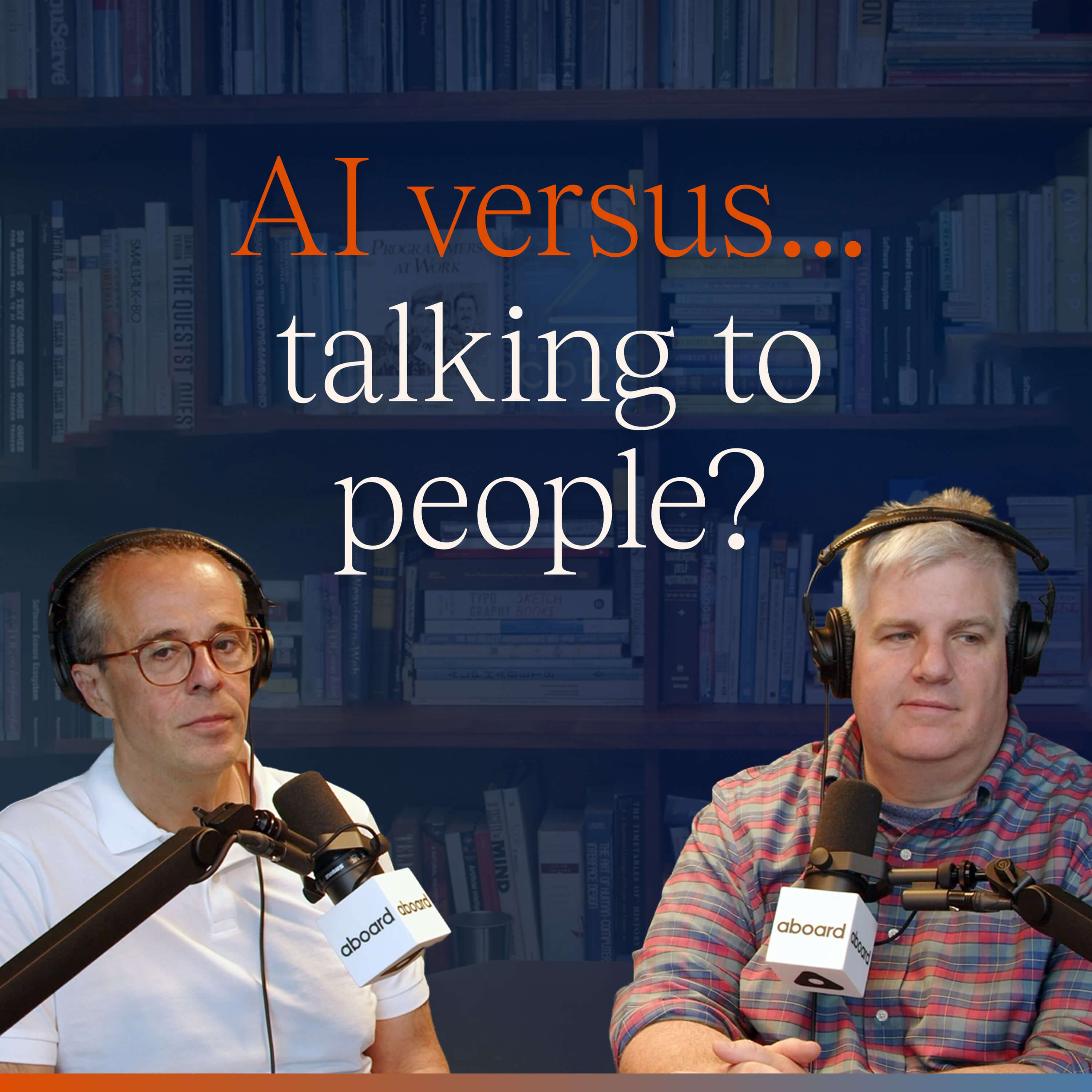
Sure, AI might bring on the end times—but you can use it to build your own tax software! On this week’s podcast, Paul and Rich are joined in the studio by Craig Mod, a writer, photographer, and self-described “software supertaster” who recently took to Claude to build a version of Quicken that suited his complicated tax-filing needs. First, they discuss the project and assess how likely it is that a non-technologist would be able to create something similar with the current tools. Then, the conversation takes a turn—towards the apocalypse. (It’s fun, we promise!)

Craig Mod: Vibe Coding Towards the Apocalypse

Sure, AI might bring on the end times—but you can use it to build your own tax software! On this week’s podcast, Paul and Rich are joined in the studio by Craig Mod, a writer, photographer, and self-described “software supertaster” who recently took to Claude to build a version of Quicken that suited his complicated tax-filing needs. First, they discuss the project and assess how likely it is that a non-technologist would be able to create something similar with the current tools. Then, the conversation takes a turn—towards the apocalypse. (It’s fun, we promise!)

Me: Doctor, I feel like I'm trapped in some kind of eternal maze, constantly rolling from place to place, but at any moment I could just roll over a cliff and die.

Doctor: That's called Marble Madness.

Kamal Menghrajani: The Limits of AI Healthcare

Doctors might be using AI to cut down on paperwork, but can these tools really be employed in clinical settings? On this week’s podcast, Paul and Rich sit down in the studio with Dr. Kamal Menghrajani, a practicing oncologist and lecturer at Harvard Medical School who was previously a member of the Biden White House’s “Cancer Moonshot” team. After she explains how AI is helping in her work, she lays out its real limitations—and discusses how these technologies can distract from more systemic approaches like better patient prevention and screening. Plus: Are her medical students allowed to use LLMs?

Kamal Menghrajani: The Limits of AI Healthcare

Doctors might be using AI to cut down on paperwork, but can these tools really be employed in clinical settings? On this week’s podcast, Paul and Rich sit down in the studio with Dr. Kamal Menghrajani, a practicing oncologist and lecturer at Harvard Medical School who was previously a member of the Biden White House’s “Cancer Moonshot” team. After she explains how AI is helping in her work, she lays out its real limitations—and discusses how these technologies can distract from more systemic approaches like better patient prevention and screening. Plus: Are her medical students allowed to use LLMs?

Why AI Makes Things Worse for Enterprise Teams

Why are so few engineering teams reaping the benefits of AI? On this week’s episode, Paul presents Rich with the findings from a recent report from CircleCI and Thoughtworks on the productivity of enterprise teams using LLMs. While there’s been a dramatic increase in throughput—the amount of code produced—across the board, just 5% of orgs are seeing real gains from these tools, while the majority struggle with errors, bugs, and lower productivity than before AI was introduced. As Paul puts it: “The advantages of this technology are not equally distributed.”

Why AI Makes Things Worse for Enterprise Teams

Why are so few engineering teams reaping the benefits of AI? On this week’s episode, Paul presents Rich with the findings from a recent report from CircleCI and Thoughtworks on the productivity of enterprise teams using LLMs. While there’s been a dramatic increase in throughput—the amount of code produced—across the board, just 5% of orgs are seeing real gains from these tools, while the majority struggle with errors, bugs, and lower productivity than before AI was introduced. As Paul puts it: “The advantages of this technology are not equally distributed.”

Andrew Marantz: What’s Wrong With Sam Altman?

What’s wrong with Sam Altman? Ask the guy who spent 18 months reporting on him. On this week’s podcast, Paul and Rich are joined by New Yorker staff writer Andrew Marantz, who recently put out a lengthy article on the OpenAI chief that he co-reported with Ronan Farrow. After they dive into some of the specific details of the piece, they discuss the broader questions Altman’s position in the industry raises. If AI really is as powerful as he claims it will someday be, why are we allowing one person to have that much power over it?

Andrew Marantz: What’s Wrong With Sam Altman?

What’s wrong with Sam Altman? Ask the guy who spent 18 months reporting on him. On this week’s podcast, Paul and Rich are joined by New Yorker staff writer Andrew Marantz, who recently put out a lengthy article on the OpenAI chief that he co-reported with Ronan Farrow. After they dive into some of the specific details of the piece, they discuss the broader questions Altman’s position in the industry raises. If AI really is as powerful as he claims it will someday be, why are we allowing one person to have that much power over it?

Breaking: Software Work Still Difficult

What does it take to make a really good product with AI tools? On this week’s podcast, Paul walks Rich through his recent adventures building a robust aggregated newsletter tool—first to track the AI industry, then generalized and customizable for any industry. Vibe-coding platforms continue to evolve, but you still need a lot of technical knowledge to make something that really works. Is that high bar likely to lower in the coming months and years?

Breaking: Software Work Still Difficult

What does it take to make a really good product with AI tools? On this week’s podcast, Paul walks Rich through his recent adventures building a robust aggregated newsletter tool—first to track the AI industry, then generalized and customizable for any industry. Vibe-coding platforms continue to evolve, but you still need a lot of technical knowledge to make something that really works. Is that high bar likely to lower in the coming months and years?

Andrew Leland: Hacking Disability with AI

“The blind vibe-coding revolution is upon us.” On this week’s podcast, Paul and Rich are joined by Andrew Leland, the author of the Pulitzer-finalist The Country of the Blind: A Memoir at the End of Sight, to discuss how blind and low-vision people are using AI tools to create and adapt software to suit their accessibility needs. With limits to what any out-of-the-box software or device might do, is AI the way to give disabled people technological solutions that really work? Plus: Rich bravely makes it through the whole recording despite being surrounded by two massive Emacs stans.

Andrew Leland: Hacking Disability with AI

“The blind vibe-coding revolution is upon us.” On this week’s podcast, Paul and Rich are joined by Andrew Leland, the author of the Pulitzer-finalist The Country of the Blind: A Memoir at the End of Sight, to discuss how blind and low-vision people are using AI tools to create and adapt software to suit their accessibility needs. With limits to what any out-of-the-box software or device might do, is AI the way to give disabled people technological solutions that really work? Plus: Rich bravely makes it through the whole recording despite being surrounded by two massive Emacs stans.

Every day

Every time my feed reader boots up, usually when I restart my machine after Apple forces me, it produces a tiny red lightning bolt: Feeds that are gone. Click to remove them forever. Some I don't remember—a stray interest in Egyptology, leading me to follow some random academic, and they finally let the domain expire and get the lightning bolt. Such is life. My RSS feed file must be 20 years old at this point, through multiple careers and hobbies. It's full of such things, the OPML of Theseus. But sometimes it is old URLs I recognize—names, ideas, things bubbling up. Usually I just tell it to stop checking; sometimes I go see what's there now. Sometimes people have moved on to new endeavors and updated the site, and their RSS feeds—which were anchored to blogs not updated in a decade—finally stopped caching. Domains have expired and Bitcoin has moved in, or GoDaddy DNS now squats there. We move on, and so does DNS—although there is a sense of rot; it's pretty rare that the good old thing is replaced by a good new thing. Sometimes it makes someone else pop into my head and I go look—what is wood s lot up to and he passed nearly a decade ago. But the site is still there, on the National Capital FreeNet. And that is a blessing. But I also think about the last Tweet, the last Facebook post, the last blog post. How will these shapes metamorphasize? Will someone hold up a sugarcube-sized bit of glowing metal and say, “check it out, it's the Internet” that word itself pointing to something ancient and gone? Because it will happen. It must. We won't outlive it, ourselves, but one day there will be no need for servers and clients, and old decrepit protocols, and the last server will be turned off, save for a few decrepit hobbyists, who still have what they think of as blogs, like some people still have swords, or weave by hand.

Inviting the Aliens

I had a grand idea for a post but the login system was broken and now I've forgotten it. Anyway I'm scattered. AI is changing and ruining everything, and I'm committed to riding the wave, but it's tiring. I had a bunch of writing projects but I've been vibe-coding proofs of concepts at work to help things along. I've never thought harder or more densely and to less effect. I worry that we're a comedy in the universal sitcom. Or that the watchers find mortality hilarious. Or the simulation is just a Chuck Lorre production. Like many men my age and demographic I spent a few years learning about Ancient Rome. But I realized walking into the office the other day—and there is a pretty view—I really don't need to wonder what it was like any longer, living as some sort of wine merchant in a giant city in a time of total war and endless corruption. It was just like this. They'll talk about us the same way, with a mix of disgust and excitement. Some poor dork of 3200AD will be amazed at our awful diets and the disfigured faces of the emperor's female viziers.

The AI Consulting Paradox

Employees at the big consulting firms are being told to use AI. Are they going to automate themselves out of a job? On this week’s podcast, Paul and Rich discuss a recent set of directives from the CEO of PricewaterhouseCoopers about AI adoption and consider what they frame as the “AI consulting paradox”: To show value, consultants need to introduce AI into their client relationships, potentially cutting their own value as a result. How will consulting manage this transition in the short or long term? Plus: Paul reports on his recent conversations with a New School journalism class that visited the office and shared their feelings about using AI.

The AI Consulting Paradox

Employees at the big consulting firms are being told to use AI. Are they going to automate themselves out of a job? On this week’s podcast, Paul and Rich discuss a recent set of directives from the CEO of PricewaterhouseCoopers about AI adoption and consider what they frame as the “AI consulting paradox”: To show value, consultants need to introduce AI into their client relationships, potentially cutting their own value as a result. How will consulting manage this transition in the short or long term? Plus: Paul reports on his recent conversations with a New School journalism class that visited the office and shared their feelings about using AI.

Hilary Mason: Product First, Then AI

Sure, you can build “stuff” with AI, but is anyone paying attention to product these days? On this week’s episode, Paul and Rich sit down with someone who is: Hilary Mason, CEO of the immersive online roleplaying game company Hidden Door. After discussing Hilary’s background in data science and machine learning, Paul takes a spin through a game scenario (Brooklyn vampires in a fantasy tavern!) while Hilary outlines the product decisions around Hidden Door’s game mechanics, AI-related or otherwise. Plus: Rich outlines his own attempts to make a game with AI for a family gathering, which, in his words, “led to children crying.”

Hilary Mason: Product First, Then AI

Sure, you can build “stuff” with AI, but is anyone paying attention to product these days? On this week’s episode, Paul and Rich sit down with someone who is: Hilary Mason, CEO of the immersive online roleplaying game company Hidden Door. After discussing Hilary’s background in data science and machine learning, Paul takes a spin through a game scenario (Brooklyn vampires in a fantasy tavern!) while Hilary outlines the product decisions around Hidden Door’s game mechanics, AI-related or otherwise. Plus: Rich outlines his own attempts to make a game with AI for a family gathering, which, in his words, “led to children crying.”

we used to live in a society
A screenshot from the song Jerk Out (1990) by The Time. A night scene in a dark room with skyscrapers out the window. Morris Day has told a beautiful woman he wants to sleep alone and asked her to leave her number by his “data bank,” which appears to be in the Compaq Presario line, and is the best-lit thing in the room. She is unhappy with this situation and about to leave. The eye cannot look away from the laptop. It is a sad situation but the laptop looks wonderful.

Alt Text: A screenshot from the song Jerk Out (1990) by The Time. A night scene in a dark room with skyscrapers out the window. Morris Day has told a beautiful woman he wants to sleep alone and asked her to leave her number by his “data bank,” which appears to be in the Compaq Presario line, and is the best-lit thing in the room. She is unhappy with this situation and about to leave. The eye cannot look away from the laptop. It is a sad situation but the laptop looks wonderful.

New Words for a New Industry

AI is blurring—and even destroying—the distinctions between disciplines. Do we need a new way to talk about work? On this week’s episode, Paul tests out a few of his AI-era neologisms on a skeptical Rich: Perhaps you are a “custolient,” looking to purchase the services of a “praygency” for your next project? (Yes, Paul insists the “y” in “praygency” is vital.) Are these new blended terms helpful, or just a way of talking around a very uncertain landscape?

New Words for a New Industry

AI is blurring—and even destroying—the distinctions between disciplines. Do we need a new way to talk about work? On this week’s episode, Paul tests out a few of his AI-era neologisms on a skeptical Rich: Perhaps you are a “custolient,” looking to purchase the services of a “praygency” for your next project? (Yes, Paul insists the “y” in “praygency” is vital.) Are these new blended terms helpful, or just a way of talking around a very uncertain landscape?

Evan Ratliff: Preparing for a Ridiculous Future

Is the future of work sitting back and watching your company of bots plan their offsite? On this week’s episode, Paul is joined in the studio by journalist Evan Ratliff, the host and creator of the wildly popular Shell Game podcast, which is about, per the show’s description, “how Evan tried to build a real startup, run by fake people.” Evan’s AI agents were an exercise in immersive journalism (and yes, they did in fact go wild planning their offsite), but would he ever consider running a company of bots for real?

Evan Ratliff: Preparing for a Ridiculous Future

Is the future of work sitting back and watching your company of bots plan their offsite? On this week’s episode, Paul is joined in the studio by journalist Evan Ratliff, the host and creator of the wildly popular Shell Game podcast, which is about, per the show’s description, “how Evan tried to build a real startup, run by fake people.” Evan’s AI agents were an exercise in immersive journalism (and yes, they did in fact go wild planning their offsite), but would he ever consider running a company of bots for real?

Loading...