can you imagine what it was like to be at the first performance of spem in allium in 1570 people must have been absolutely losing their minds ➛
Ftrain, by Paul Ford
20 Most Recent
I genuinely appreciate the way Rush fans are like, “Oh no, they're terrible. It's going to be a terrible concert. Geddy Lee may or may not be alive. I am so excited to see them.” ➛
This is early days but super interesting. It's good to see something focused on building instead of just a bot rambling.
[Quoted post]➛
The special feeling of being in The Register but it's not because you failed catastrophically.
[Quoted post]➛
Climate/data friends: We're hosting an event next Thurs 4PM in with Harvard's Public Data Project, at our office in NYC. The focus is on how to preserve climate data when it's being destroyed by the government & how to make it USEFUL to climate people. Free, all welcome, SNACKS. luma.com/aboard-fqmf ➛
I kind of forgot what launching websites is like.
[Quoted post]➛
let’s not forget the real mvp which is cloudflare‘s free tier ➛
I built a thing. I LOVED making it. It's called TinyLittleOffice. It's a web office suite (word processor, outliner, decks, spreadsheet, calculator, drawing tool, diagram maker, animator, calendar, trip planner) that stores the docs in your URL. tinylittleoffice.com?c=hgmcggn#/v... ➛
whats weird is with all the fucked up surgeries you don’t need special glasses to see the lizard faces ➛
Introducing TinyLittleOffice.com ➛
The link is the document!

Six years ago, when we were running a different company, my Aboard co-conspirator Rich Ziade had a great software idea. He called it TinySheet, and it was a ten-line spreadsheet that ran in the browser and kept all the data in its URL. That meant two things:
- The link was the document: There was absolutely nothing saved to a server. (When you put stuff after “#” in a URL, it stays local by default.)
- If you shared the link, the next person could edit the sheet (and pass it on).
Our team did a great job building this utility, and people used it and wrote about it. As far as we could tell, folks mostly used it to share simple math in Slack. Later we launched a similar tool called TinyCalendar.
We moved on, and sadly, those sites fell off the web, and the old links all broke.
Making Tiny Bigger
Now it’s 2026. Rich and I have co-founded a different firm, Aboard. We still build things for ourselves and our clients. And software is very different now. I thought to myself: What if I took Rich’s TinySheet idea and ran with it?
The result is TinyLittleOffice.com. It works using the same principles, but it also has a word processor, outliner, presentation builder, fuller-featured spreadsheet, calculator, drawing tool, diagram maker, animator, calendar, and trip planner. Here it is in my web browser:
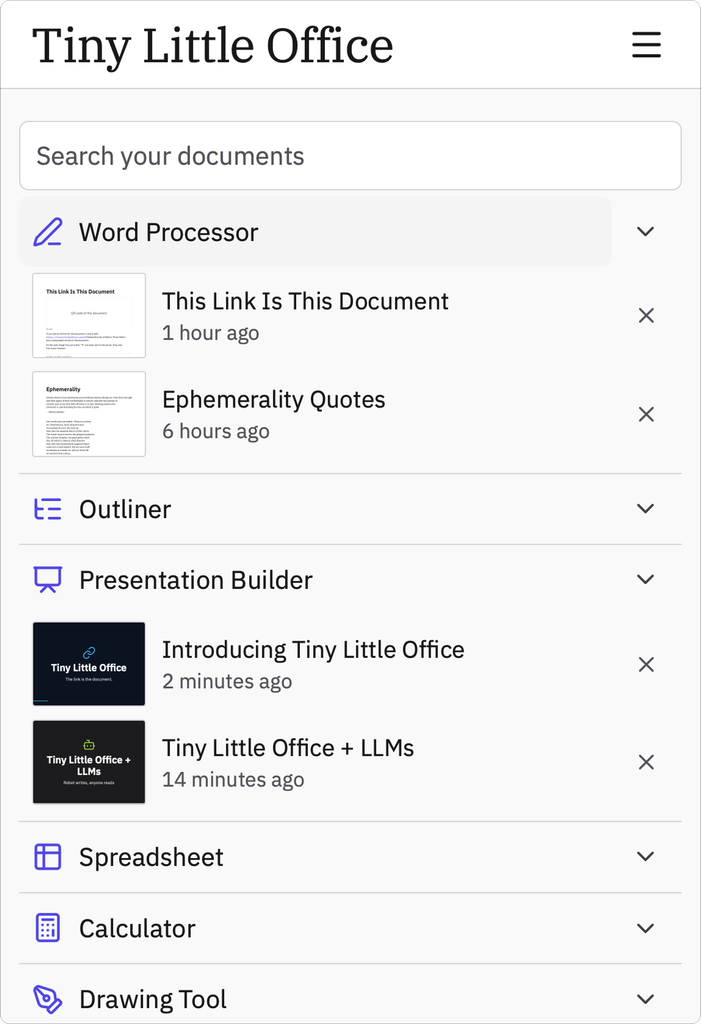
It’s for tiny documents—a couple pages, a few slides. And it still saves all the data in your link.
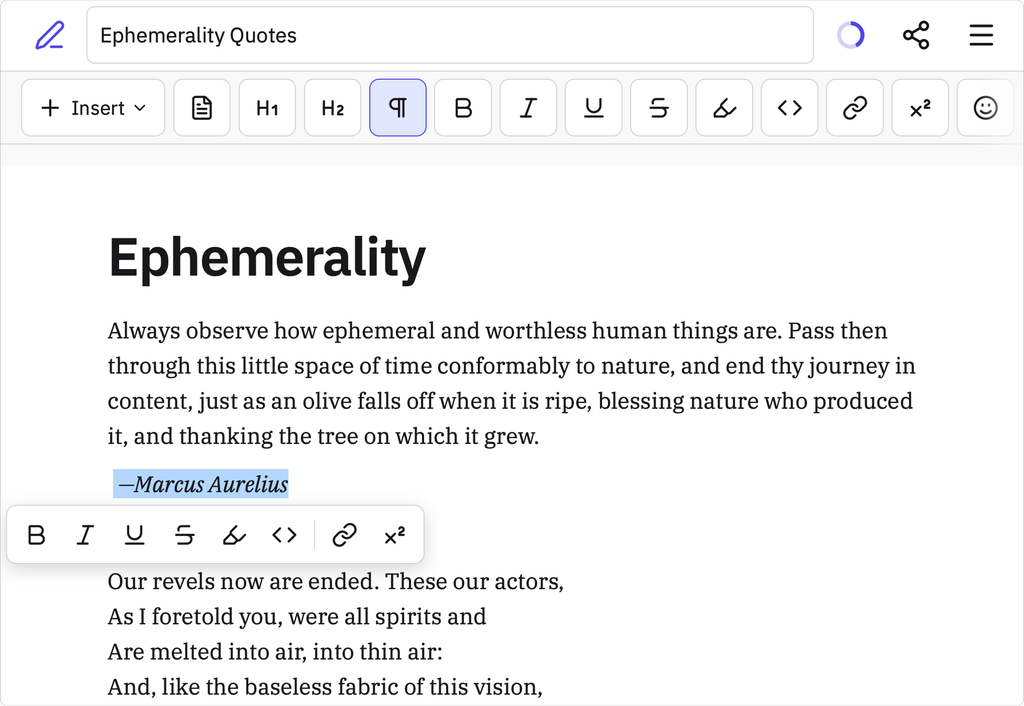
You Don’t Log In, Ever
Say you head to TinyLittleOffice.com and make a document. Now what? When you want to “save” a document you can:
- Copy the URL and paste it into chat. Now everyone in the chat has a copy they can edit. All your ISP can see is that you visited a site—the data is in the link.
- Export it as a document—PDF, PowerPoint, Markdown. Or as a QR code. If the document is a page or two long, the QR code can contain the whole document.
- Shorten the URL if it’s a bigger doc by saving it to our URL shortener. Your browser encrypts the document and sends that to a server. The “key” is in the link, after the “#”—so the server never sees what you saved. (All links expire, maximum duration is a month.)
There are lots of tradeoffs. This is not, in any way, how web apps are expected to work. The links can get unwieldy pasted in chat, and you can’t upload video or images, full stop. It’s not collaborative like Google Docs. It’s collaborative like handing out zines at a street fair.

I guess there are a few different ways of thinking about it:
- It’s disposable software! You use it and throw it away.
- If Signal was an operating system, this could, one day, aspire to be its productivity suite.
- If you post a full Tiny Little Office link to X or Bluesky, you just “saved” a file in public. (It has a Bluesky account.)
- It was built to make sense to agents—you can tell an LLM to check out TinyLittleOffice.com and use it to make small, shareable things.
But ultimately, it’s just software. It’s for using, and you’ll decide what it’s for and if it meets any of your needs.
In the meantime:
- Here’s a link to a document…explaining how the link is the document…
- And a guide to the whole system…
- And another one explaining the security profile…
- And another explaining the LLM integration.
Small Is Beautiful
Everything in tech is huge right now. Every system lives on someone else’s machine and tracks you everywhere. All the content you make with those systems is being gobbled by LLMs. Meanwhile, most normal people are in chat all day, hiding out from the mess, rambling about politics and sports on WhatsApp or coordinating mutual aid on Signal. I really enjoyed building something for them/us.
I also just kind of…like using this thing. It’s light and it doesn’t give me many options, and when I need to save something I just Slack it to myself. The outliner is my favorite part. It also allows you to embed documents in other documents, which was the dream of the entire 1990s in office software—and now that dream is extremely true.
Rich’s point in producing TinySheet was simple: Small, private things may not be profitable, but they can be valuable. People like little tools they can make their own. It’s your data, and your code. I think all of that holds even more true six years later. And it really is easier to build small than ever before.
This project is open source with the MIT license. Feel free to find fault with it! But I’d also like to see some documents you created. Post them on social media! You can save your essays into Bluesky posts. It beats screenshots of the notes app. Have fun!
The sheer velocity of content right now is unbelievable. ➛
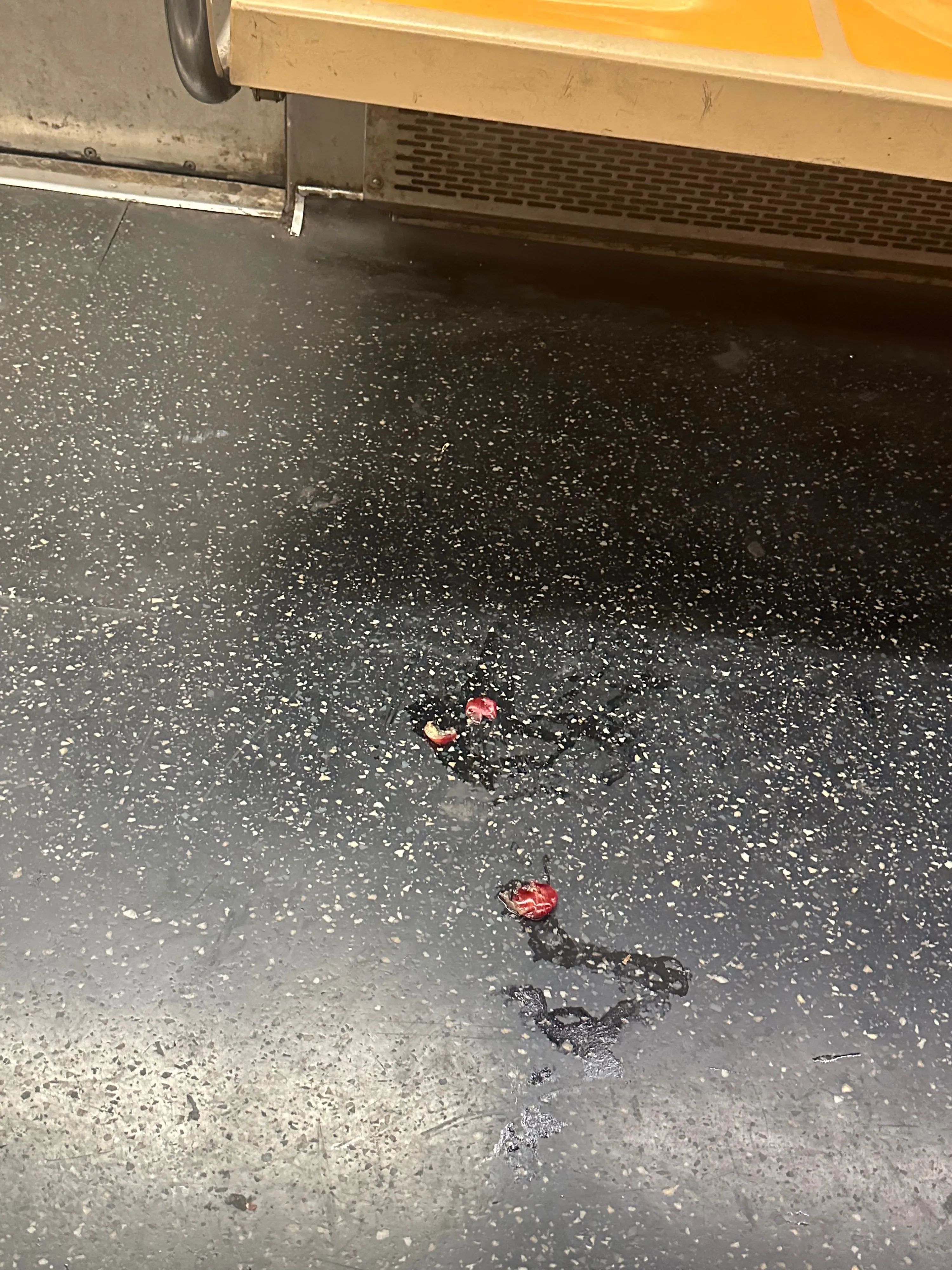
this is just to say
I have stomped on
the plums
on the 6 train
fuck them plums
 ➛
I have stomped on
the plums
on the 6 train
fuck them plums
Alt Text: Smushed plums on the floor of the 6 train
If feels like they're putting the foot down on the gas pedal in order to leap the chasm. But they fired all the physicists who could tell them to stop. ➛
Jason Goldman: From VC Pitches to AI Kill Switches
How can we get politicians and Silicon Valley on the same AI page? On this week’s episode, Paul and Rich welcome on Jason Goldman, whose long career in tech has taken him from Blogger to Twitter to the Obama administration to his current endeavor, the Center for Shared AI Prosperity. “AI capabilities are advancing faster than the political system is responding,” CSAIP’s website reads; Jason explains the challenges around and different approaches to redressing this gap. Plus: as the host of the movie podcast Escape Hatch, Jason ranks his expectations for the fall tech industry films, and makes a big prediction about Dune: Part Three.

How can we get politicians and Silicon Valley on the same AI page? On this week’s episode, Paul and Rich welcome on Jason Goldman, whose long career in tech has taken him from Blogger to Twitter to the Obama administration to his current endeavor, the Center for Shared AI Prosperity. “AI capabilities are advancing faster than the political system is responding,” CSAIP’s website reads; Jason explains the challenges around and different approaches to redressing this gap. Plus: as the host of the movie podcast Escape Hatch, Jason ranks his expectations for the fall tech industry films, and makes a big prediction about Dune: Part Three.
let's visit Julianne Moore's apartment www.youtube.com/watch?v=eewE....
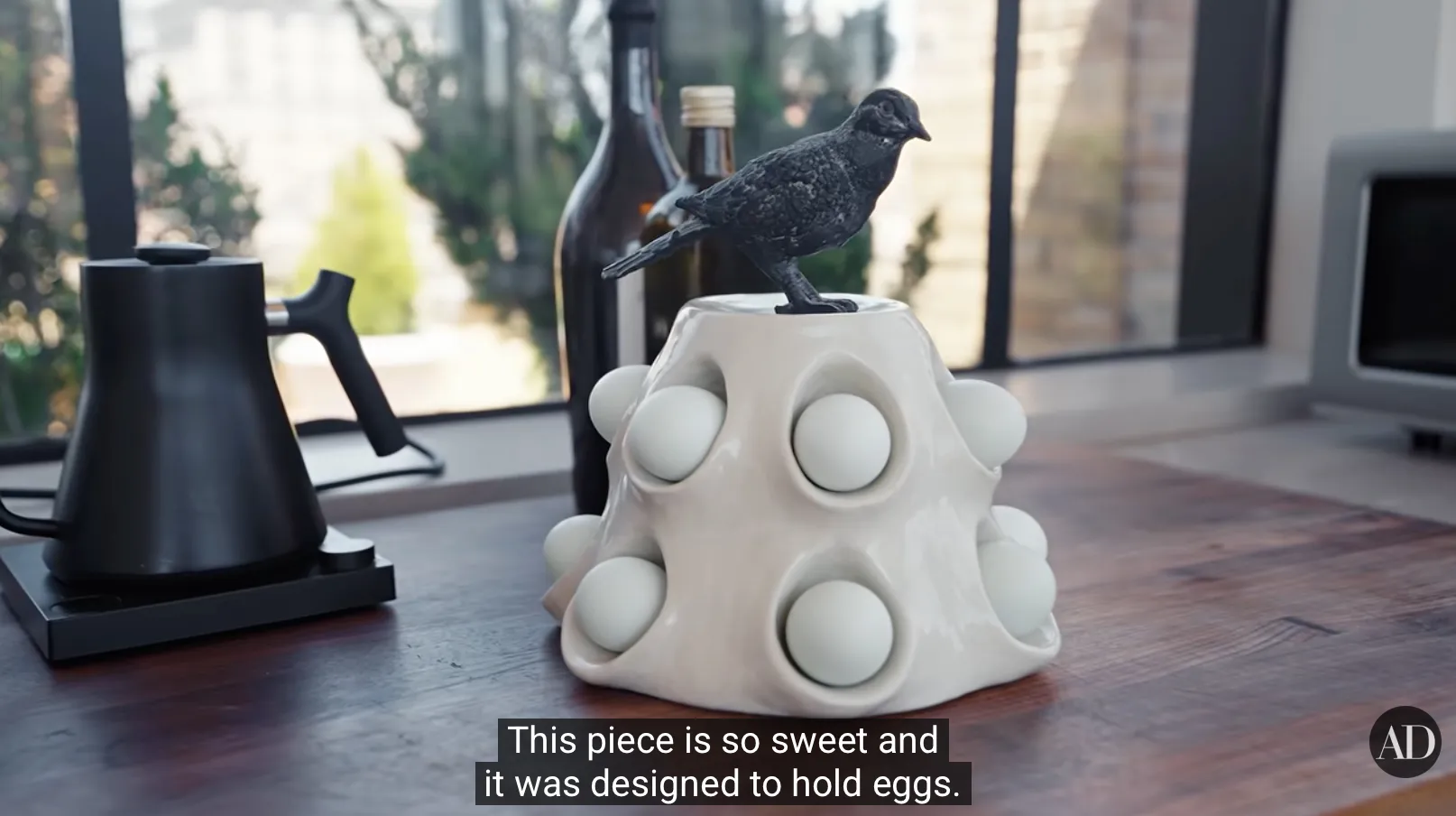 ➛
Alt Text: A knobby, vaguely pyramidal white ceramic object on a kitchen counter, perhaps a foot tall, with a black rough metal bird perched atop; the pyramidal ceramic has a series of pouchlike crevices with labial rims, nestling nine white eggs; those are the visible eggs. The caption reads "This piece is so sweet and it was designed to hold eggs." While the video does not directly address it, it is reasonable to assume that this is how new Julianne Moores are incubated.
Most New York City moment of my entire life happened yesterday. I was sitting on a bench outside of WNYC to kill time before going up and a truck driver and a couple on the sidewalk had an argument about whether they’d just seen Lenny Kravitz. ➛
If you’re looking for something to help you go to sleep I’ve got Burgess Meredith performing in the 15-century play Everyman, recorded in 1955. archive.org/details/15th... ➛
woke 1.0 may be over but I’m still excited for woke 3.0 or as i like to call it semantic woke ➛
Katie Notopoulos: There Are Still LOLs on the Internet
How is AI reshaping internet culture? On this week’s episode, Paul is joined by a journalist who has truly looked into the digital abyss: Business Insider’s Katie Notopoulos. Using a few recent AI-related stories Katie reported as a lens, they discuss the increasingly blurry boundaries between the real and the artificial on our social feeds. Katie is known for, among other things, her lists of the worst things on the internet; with AI, Paul asks, has “worst” somehow gotten “even worser”? Plus: In a classic reporter move, Katie flips the script and quizzes Paul about his 2014 essay on YouTube, “The American Room.”
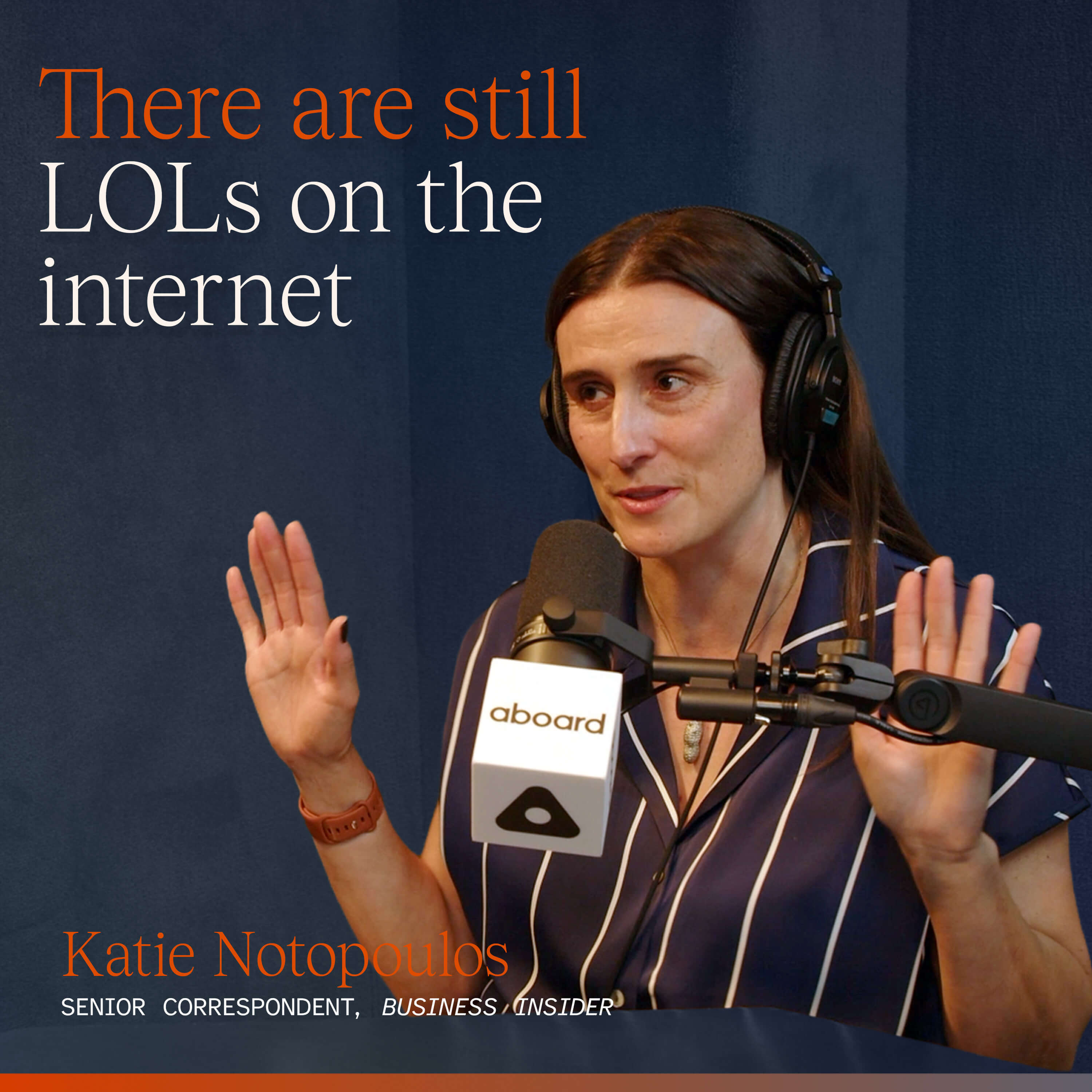
How is AI reshaping internet culture? On this week’s episode, Paul is joined by a journalist who has truly looked into the digital abyss: Business Insider’s Katie Notopoulos. Using a few recent AI-related stories Katie reported as a lens, they discuss the increasingly blurry boundaries between the real and the artificial on our social feeds. Katie is known for, among other things, her lists of the worst things on the internet; with AI, Paul asks, has “worst” somehow gotten “even worser”? Plus: In a classic reporter move, Katie flips the script and quizzes Paul about his 2014 essay on YouTube, “The American Room.”
true art here esp the little “yeah” at the end of every dad joke www.instagram.com/reel/Dd3mDOT... ➛