0-C0AST
Rum, soldering, and the lash.
The synth store is at the back of a warren of hallways in a former industrial building on the Brooklyn side of the East River. The building is vast and now given to artists’ studios, tattoo parlors, and various forms of yoga, screenprinting, and other forms of middlebrow health and craft. There are many of these culture factories around the city, liminal spaces between art and commerce, always in former warehouses where, I don’t know, horse skulls were rendered, or footmen’s boots were cobbled, or baby’s bottles were impregnated with healthful plutonium, or communists were vivisected. There is something in America that yearns to reconstitute an intentional community—to assemble artisans, and celebrate craft, like it was Roycroft in 1905. We love to re-imagine utopian commerce within the ghosts of local industry. Anyway it’s one of those.
I went not to buy anything exciting but rather simple, maintenance objects: A black metal modular case that is essentially an expensive surge protector, some power cords, and some patch cables. I was, alas, buying stuff for my stuff. That is the hobbyist’s curse.
It is a well-regarded store if you are a particular kind of nerd, and it is the subject of many appreciative Reddit threads. It moved deep into this warren after the rent got too high in Williamsburg. I go there every couple of months. The next day would be given to snow removal for myself and various older neighbors; my spouse commits me and they thank her for it. I don’t mind. We have a snowblower. But today, before—a little trip for Old Dad.
I always feel slight anxiety on entering. I’m a little seasoned for the hobby. I’m not a musician. I don’t have talent. A fraud alert goes off when I get too close to the knobs and sliders.
But I just love the gear, and learning music theory, and learning little Bach pieces, and spending hours with the very same note droning in my ears. My therapist says I like modular synths because I’m atomized and it’s a way to put myself together. I don’t know. I want that long slow waveform with a little vibrato, a little reverb. Most music has too many notes. The best music, the music I make, has one note that plays until I get angry at it, often a half hour. One day I’ll explain how many hours I’ve spent in Surge XT, looking for that one tone. I’m embarrassed by this. Others are embarrassed for me.
When I walk in I see a $32,000 analog synth the size of a washer-dryer newly arrived. I admire it. I turn one knob then turn it back. I am spoiled but I have limits.
The shopkeepers, they’re nice, especially these two, who seem to kind of...be the store. They know literally everything about the field: Every manufacturer, every method, levels of detail unimaginable to me. They tell me about a new module maker in Gowanus, contrasting digital processing to analog. I try to keep up and chitter away but I know I don’t have the details right. Never stopped me from talking before.
One of them goes over towards the 0-C0AST, a paperback-book sized device that is the antithesis of a computer—display-less, electric, glowing, studded with knobs, and patch wires coming out of multiple sockets, entering other sockets to change the flow of signal. But ultimately it can make only a very narrow range of sounds.
“I should sell you mine,” I say. “I could bring it in. It’s just sitting at home.”
Hearing this, he proceeds to patch it, tune it, pointing it to itself—no external sources. Boops emerge.
I bought mine...well I don’t remember where. Craigslist, maybe—somewhere in Brooklyn? Some Saturday morning, a bleary-eyed dude coming down to take $350 off of me? Used for sure. At the moment it was exciting but now it is a thing I own.
This person doesn’t say much as they patch and adjust. They just keep turning knobs. I am—uncertain, wanting to spend money, one foot always out the door. I didn’t expect an impromptu concert.
But then I am entranced. A minute, another minute. A million tiny little tones. Three or four wires crossing each other. “You can feed the square into the overtone like this. Take a picture,” he says, “then you can reproduce this at home.”
I take a video and I realize, watching it later, that I’m talking, not listening. It’s not an LFO, as I offer; it’s a function generator and the difference is subtle, until you decide it isn’t. The larger issue is, Can I shut up? And the answer, I think, is No. But I can try.
I realize haven’t understood this synthesizer at all. It’s absolutely full of ideas, of West Coast and East Coast ideologies of synthesis; it’s filterless, but has all kinds of different ways to achieve tonalities, and while before I’ve found it kind of noodly, that’s because I’m noodly and uninformed; in the hands of someone who knows what overtone and multiply mean—not just what they do, but what they mean—it becomes an extension of their thoughts, a living thing. Each note gets imbued with subnotes, wrapped in envelopes of various angles, just a few things feeding into each other and making as much sound as one might ever need. I watch him work on it, with gentle awareness, treating it not as a gadget or toy, or as a password to a secret club, but as an instrument.
It might not sound amazing to you—you’d need to have struggled with this tiny instrument to know that you were hearing something special—but to me it sounds guttural, textural, full of ideas. Now this is not some miracle. It’s knowledge and patience, and I lack both.
I keep thinking I should offer some fact, some data they can use, but I’m helpless, and then I remember that’s the point: I’m a hobbyist, visitor, customer. That’s my role.
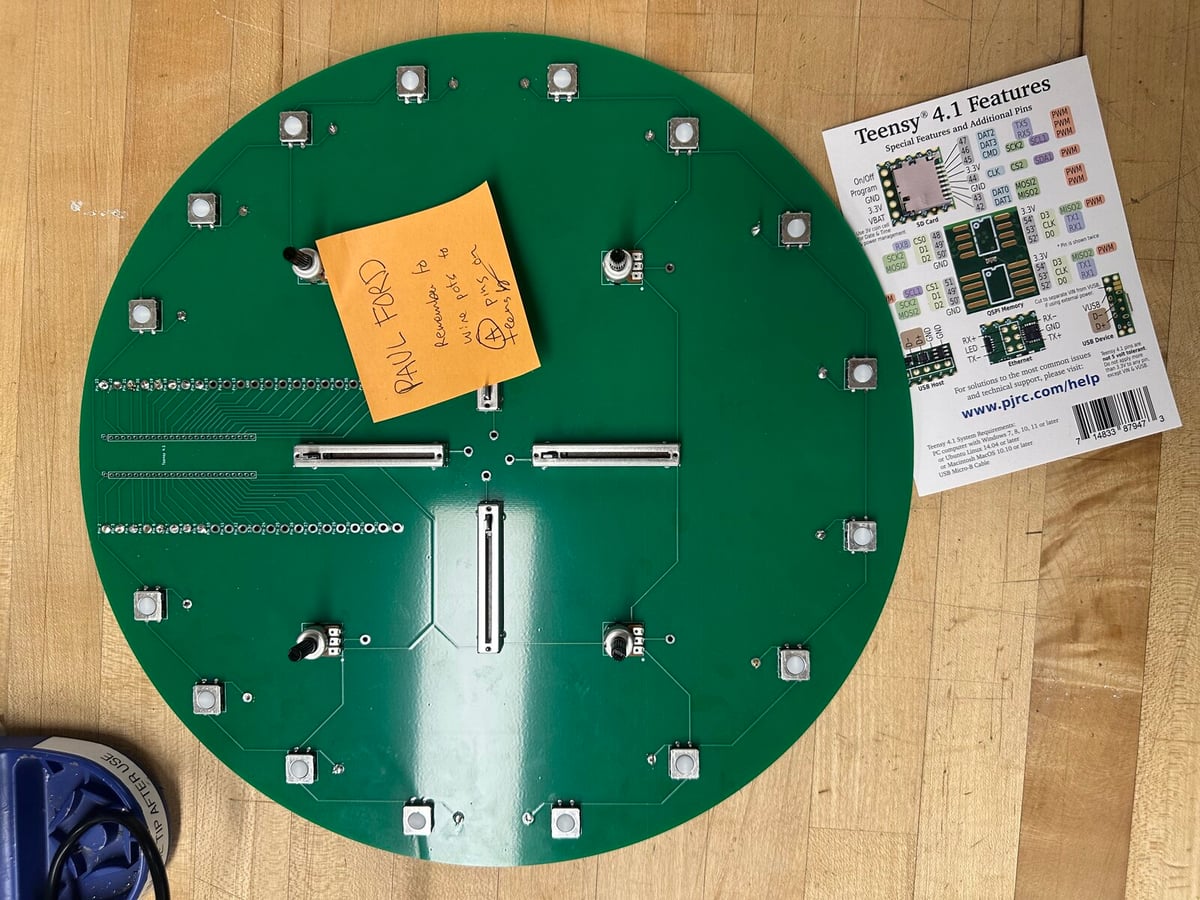
I took a synth class a few months ago at the School of Visual Arts. A night class. It was the best thing. The teacher seemed to be in his 20s. He taught us to solder and program microcontrollers that could then be played like instruments. I didn’t get to know my fellow students, except to nod at them. I just sat in a place surrounded by machines for making things. It was wonderful.
I’d been a teacher in the graduate school in the same building not long ago. It was hard and I never felt good at it. But here I was a student, and my solder joints were...not good. I needed help, and received it, and felt happy.
I realized that I’d approached teaching wrong. I felt beholden to the students. I wanted them to get what was in my brain. I felt on the hook. But instead I should have just created a space where it was interesting to learn and talked about things in a very paced, orderly way.
You get used to being the teacher, the source of information, the provider. Not so much arrogance but habit. I tell things to my teens. I exchange information over coffee. I parse signal and translate it. Most of my friends, we have two conversations at once, talking right over each other.
At work I boss and thought lead and grumble. My midlife crisis takes the form of being an amateur wherever I can—a student, a patient, forced into humility by the tasks at hand. My piano lesson is exactly one lesson, repeated over week:
Go.
Slow.
So I left the store into the cold. They sold me a synth I already had. What a gift! They also gave me a stack of ICE OUT posters to distribute.
I’ve spent hours trying to patch. Using the same wires. I can’t quite get the sound in the video, in the store. It’s not that it’s not acoustically the same, it’s that I don’t understand. I can’t get from one sound to another. My hands don’t get it, my ears don’t get it, and I don’t understand the signal flow. So I have to go slow, slow, slow. In an age of panic. As the world warms. As the culture melts and robots grow voices.
As I type this I have a Make Noise 0-C0AST playing a modified Krell patch. For an hour. Little tweaks. I know so much more than I did two days ago. And very little. The sound is undistinguished—but also...mine. No one else can hear what I hear. It’s not actually very good. But it is mine. Spiritual people will say: There are teachers everywhere! You just need to open your sclerotic hearts! I’m pretty basic so I just end up buying synths, or hiring a piano teacher. I think it works out about the same.